
White Label Development vs In-House Developers: Which Is Better for Agencies?
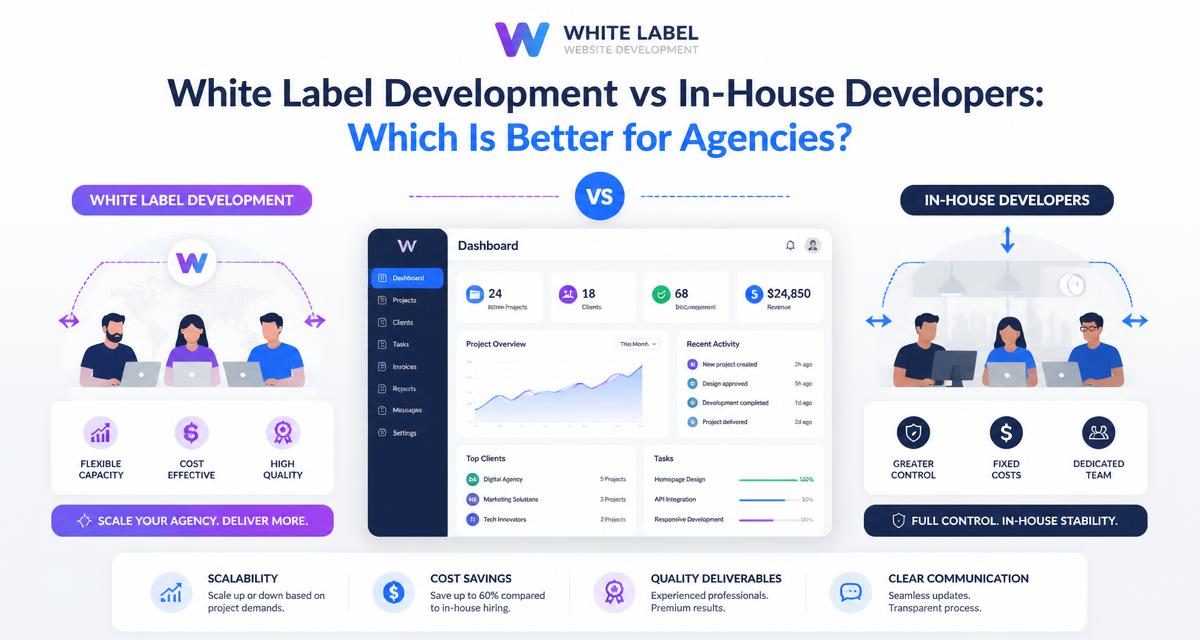
As an agency grows, one question eventually becomes unavoidable:
Should you hire developers in-house, or use a white label development partner?
Both models can work extremely well. Both can also become expensive when used in the wrong situation.
An in-house development team gives an agency direct control, deep internal knowledge, and long-term team continuity. White label development provides flexible capacity, access to specialized skills, and the ability to expand services without immediately adding permanent payroll.
The right choice depends on factors such as:
- project volume
- revenue predictability
- development complexity
- hiring budget
- management capacity
- required turnaround
- client expectations
- technology requirements
- profit margins
- long-term business strategy
For many agencies, the answer is not simply white label or in-house. A hybrid model—maintaining a core internal team while using a trusted white label development partner for overflow or specialized projects—can provide the best balance.
This guide compares white label development vs in-house developers across cost, control, scalability, quality, communication, profitability, hiring risk, specialist access, client management, and long-term agency growth.
Table of Contents
- What Is White Label Development?
- What Is In-House Development?
- White Label Development vs In-House Developers: Quick Comparison
- The Biggest Difference: Fixed Capacity vs Flexible Capacity
- Cost Comparison
- Hiring and Recruitment Costs
- Payroll and Fixed Overhead
- Cost per Project
- Scalability
- Speed of Adding Capacity
- Access to Specialized Skills
- Quality Control
- Communication
- Project Management
- Client Communication and Branding
- Confidentiality
- Control Over Developers
- Availability and Reliability
- Knowledge Retention
- Technology Flexibility
- Handling Workload Peaks
- What Happens During Slow Months?
- Profit Margin Comparison
- White Label Development for Small Agencies
- In-House Development for Established Agencies
- The Hybrid Development Model
- When White Label Development Is Better
- When In-House Development Is Better
- When a Hybrid Model Is Better
- How to Calculate Which Model Is More Profitable
- Common Mistakes Agencies Make
- Frequently Asked Questions
- Final Verdict
What Is White Label Development?
White label development is an outsourcing model in which an external development company performs work on behalf of another agency while the agency continues delivering the service under its own brand.
The basic relationship is:
Client → Your Agency → White Label Development Partner
The client usually hires your agency.
Your agency may handle:
- sales
- discovery
- strategy
- proposals
- client communication
- project management
- billing
- final delivery
The white label partner handles agreed technical responsibilities, which may include:
- website development
- WordPress development
- WooCommerce development
- frontend development
- landing pages
- custom functionality
- integrations
- technical fixes
- website maintenance
The exact level of partner visibility depends on the arrangement.
In a strict white label model, the development company remains behind the scenes while your agency maintains the client relationship.
If you want a deeper explanation of the model itself, see our guide on what is white label web development.
Ready to add development capacity behind your brand? Explore our Agency Partner Program and start delivering websites under your own agency name.
What Is In-House Development?
In-house development means employing developers directly within your own company.
They are members of your internal team rather than external suppliers.
Depending on the size of the agency, an in-house team might include:
- frontend developers
- backend developers
- WordPress developers
- ecommerce developers
- technical project managers
- QA specialists
- DevOps engineers
- designers
The agency is directly responsible for:
- recruitment
- salaries
- benefits
- equipment
- software
- management
- training
- performance reviews
- workload planning
- retention
In-house development gives the agency significant control, but it also creates fixed operating costs.
White Label Development vs In-House Developers: Quick Comparison
| Factor | White Label Development | In-House Developers |
|---|---|---|
| Initial hiring cost | Low | High |
| Fixed payroll | Lower | Higher |
| Scale capacity quickly | Easier | Harder |
| Direct management control | Moderate | High |
| Specialist access | Often broad | Depends on hires |
| Long-term internal knowledge | Lower | Higher |
| Recruitment responsibility | Provider handles it | Agency handles it |
| Slow-month risk | Lower | Higher |
| Busy-month flexibility | High | Limited by headcount |
| Team culture integration | Lower | Higher |
| Project-based cost | Easier to isolate | Harder to calculate |
| Confidentiality management | Requires contracts/process | More internal |
| Developer availability | Depends on partner | Usually predictable |
| Training investment | Lower | Higher |
| Employee retention risk | Lower for agency | Higher |
| Best for unpredictable demand | Strong | Weak–Moderate |
| Best for continuous proprietary work | Moderate | Strong |
Neither model wins every category.
The correct decision depends on what your agency needs development to accomplish.
The Biggest Difference: Fixed Capacity vs Flexible Capacity
One of the most important differences between white label and in-house development is how capacity is purchased.
With an in-house team, you generally purchase capacity in advance.
You hire developers and pay them whether the project pipeline is full or not.
With white label development, you can often purchase capacity when needed.
This changes the agency's risk profile.
Imagine your agency has the following monthly workload:
| Month | Website Projects |
|---|---|
| January | 3 |
| February | 7 |
| March | 4 |
| April | 12 |
| May | 5 |
| June | 2 |
An internal team must be staffed for some expected level of demand.
If you hire enough people to comfortably handle 12 projects, those employees may be underutilized during months with two or three projects.
If you staff for four projects, you may struggle badly during months with 10 or 12.
White label development can make those fluctuations easier to manage.
You can maintain your core operating team and increase external capacity when demand rises.
Cost Comparison
Cost is usually one of the first things agencies compare.
But comparing the hourly rate of a white label provider with the salary of an employee produces an incomplete answer.
The correct comparison is:
Total Cost of Reliable Development Capacity
For an in-house developer, that can include more than salary.
Potential costs include:
- base salary
- employer taxes
- benefits
- paid leave
- bonuses
- health or insurance benefits
- computer equipment
- software
- office costs
- recruitment
- onboarding
- management
- training
- downtime
For a white label provider, costs may include:
- project fees
- hourly fees
- retainer
- dedicated-resource fee
- project management charges
- additional revision costs
- rush fees
You must compare the whole system.
Example: In-House Developer Cost
Suppose an agency hires a developer with a salary equivalent to:
$60,000 per year
The real cost may be higher after adding:
- payroll-related expenses
- equipment
- software
- recruitment
- training
- management time
- paid leave
Assume the total annual employer cost reaches:
$75,000
That equals approximately:
$6,250 per month
Now suppose the developer is only effectively utilized on billable client work 65% of the time.
The cost of productive development capacity becomes significantly higher than simply dividing salary by working hours.
Internal meetings, administration, training, holidays, downtime, and non-billable work all affect utilization.
Example: White Label Development Cost
Now imagine an agency purchases development project by project.
| Month | Cost |
|---|---|
| January | $4,000 |
| February | $7,500 |
| March | $5,000 |
| April | $11,000 |
| May | $6,000 |
| June | $3,000 |
The agency's costs rise and fall with workload.
This creates less fixed-cost exposure.
However, the white label company also needs to earn a profit.
Therefore, per-hour or per-project production cost may sometimes be higher than the marginal cost of a fully utilized internal employee.
That is the tradeoff:
In-house can be economically efficient when utilization is consistently high.
White label can be economically efficient when demand is variable.
Hiring and Recruitment Costs
Hiring developers is not instant.
A typical hiring process can involve:
- job advertising
- recruiter fees
- CV screening
- technical interviews
- test projects
- culture interviews
- salary negotiation
- notice periods
- onboarding
- training
During this process, your agency may still have development projects waiting.
A white label partner can reduce much of that recruitment burden.
Instead of hiring five individual specialists, an agency may gain access to a partner that already has:
- WordPress developers
- frontend developers
- backend developers
- QA specialists
- ecommerce developers
That can be especially valuable when the agency needs capacity quickly.
Payroll and Fixed Overhead
An in-house developer is a fixed or relatively fixed cost.
If clients stop buying website projects for two months, payroll still exists.
That does not make employees a bad investment.
It simply means the agency takes on utilization risk.
White label development shifts more of that risk to the provider.
If your agency has no projects, you may have little or no project-based development spending.
This can protect cash flow for agencies with inconsistent demand.
Cost Per Project
Project-level profitability can be easier to understand with white labeling.
Suppose:
- Development partner cost: $2,500
- Internal project management and QA: $1,000
- Total delivery cost: $3,500
- Client price: $6,000
The project contribution before wider overhead is:
$2,500
With in-house developers, assigning exact costs to individual projects can be more complicated because the employee's compensation is spread across:
- multiple projects
- meetings
- internal work
- idle time
- support tasks
- training
Both models can be profitable.
But agencies should use appropriate cost accounting rather than assuming internal development is "free" once employees are salaried.
Scalability
White label development usually has an advantage when an agency needs to scale quickly.
Imagine your agency signs five new clients in the same month.
With an internal team, you may need to:
- advertise roles
- interview candidates
- make offers
- wait through notice periods
- onboard developers
- train them
That may take weeks or months.
With an established white label development partner, additional project capacity may be available much sooner.
However, white label capacity is not unlimited.
Agencies should still ask potential partners:
- How many concurrent projects can you support?
- How quickly can you add capacity?
- What happens during high-demand periods?
- Do you have backup developers?
- How are urgent projects handled?
A supplier that works well for two projects per month may not necessarily support 25.
Speed of Adding Capacity
Consider an agency that suddenly wins:
- three WordPress websites
- two WooCommerce stores
- four landing pages
Hiring enough specialists internally for a short-term spike may make little sense.
A white label team can help absorb the additional workload.
That makes external development especially useful for:
- seasonal demand
- campaign launches
- temporary overflow
- rapid growth
- large one-off contracts
Access to Specialized Skills
An agency may need many development skills without needing each one full-time.
For example:
- Monday's project requires WordPress
- Tuesday's project requires WooCommerce
- Wednesday requires JavaScript integration
- Thursday requires website performance work
- Friday requires API integration
Hiring full-time specialists for every technology can become expensive.
A white label company may provide access to multiple specialists through one partnership.
This can significantly expand an agency's service capabilities.
Our services, for example, include white label WordPress development, white label WooCommerce development, and white label landing page development.
Where In-House Teams Have an Advantage
Specialist access is not everything.
An internal developer may develop a much deeper understanding of:
- your agency's preferred stack
- client history
- internal processes
- design system
- code standards
- recurring technical problems
- proprietary technology
That accumulated knowledge can increase efficiency over time.
For agencies with highly standardized or proprietary development work, this institutional knowledge can be extremely valuable.
Quality Control
One common argument for in-house development is:
"We can control the quality better if developers work for us."
Sometimes that is true.
You have direct influence over:
- hiring standards
- coding practices
- QA
- performance reviews
- training
- internal processes
But employment status alone does not guarantee quality.
A weak internal team can produce poor work.
A highly structured external team can produce excellent work.
The real factors include:
- developer skill
- documentation
- technical standards
- QA process
- accountability
- project management
- review procedures
Agencies using external developers should maintain their own quality gate.
The development partner performs QA.
Then the agency reviews the project.
Only after those checks should the client see it.
Communication
In-house communication is usually simpler.
An internal developer may be available through:
- Slack
- Teams
- internal meetings
- direct calls
- project management software
There are fewer organizational boundaries.
White label development introduces another layer.
Communication often becomes:
Client → Agency → White Label Partner → Developer
Then:
Developer → White Label Partner → Agency → Client
This increases the possibility of misunderstandings.
The solution is structured communication.
Agencies should use:
- clear project briefs
- documented requirements
- centralized feedback
- screenshots
- acceptance criteria
- agreed response expectations
A strong external workflow can still be highly efficient.
Project Management
In-house developers still require management.
Someone needs to decide:
- priorities
- deadlines
- workloads
- technical requirements
- approvals
White label development also requires project management, but some responsibilities may shift to the partner.
A mature white label provider may have its own:
- project manager
- development lead
- QA process
- workload planning
This can reduce some operational burden for the agency.
However, the agency still needs someone who owns the client's expectations.
The supplier cannot fully replace client-side account management.
Client Communication and Branding
This is where white label development differs from ordinary outsourcing.
Your agency can remain the primary client-facing organization.
The client may see:
- your proposal
- your email
- your project manager
- your invoice
- your reporting
- your brand
while the development team works behind the scenes.
This allows an SEO, marketing, design, or consulting agency to offer development without redirecting the client to another company.
A structured agency partner relationship can therefore help preserve the agency's broader client relationship.
Want to sell development under your own agency brand? Contact us to learn how our white label delivery keeps your client relationships intact.
Confidentiality
Internal employees already operate within the agency's organizational structure, although appropriate employment agreements and access controls are still important.
White label relationships require additional attention because information crosses organizational boundaries.
An external partner may receive:
- client credentials
- staging access
- hosting access
- designs
- business information
- analytics
- proprietary documents
Agencies should consider:
- NDA terms
- client-contact rules
- data access
- credential management
- subcontractor access
- intellectual-property ownership
- portfolio permissions
You can review our NDA and confidentiality information for more context.
Control Over Developers
In-house teams provide more direct control.
The agency decides:
- work hours
- priorities
- processes
- standards
- technology
- meetings
- training
With white label development, you control the agreed deliverable and relationship, but you do not necessarily control how the provider manages its employees.
That means the relationship should be managed through:
- clear scopes
- deadlines
- service expectations
- communication rules
- QA standards
Trying to manage an external provider exactly like an employee often creates unnecessary friction.
Manage outcomes and agreed processes instead.
Availability and Reliability
An internal developer is typically assigned to your company.
A white label partner may support several agencies.
That creates different risks.
In-House Risk
Your developer may:
- become sick
- take leave
- resign
- become overloaded
If your entire technical department is one person, that creates significant dependency.
White Label Risk
Your provider may:
- have competing project priorities
- experience capacity problems
- change staff
- have communication delays
A larger provider can sometimes offer greater redundancy because another developer can take over.
The key question is not:
Internal or external?
It is:
What happens when the person responsible for the project becomes unavailable?
Knowledge Retention
In-house development has an important advantage here.
Employees accumulate knowledge about:
- internal systems
- client preferences
- recurring integrations
- coding standards
- workflows
- historical decisions
That knowledge remains inside the agency—assuming employees stay.
External partners can also develop long-term familiarity with your business, especially when the relationship lasts for years.
But agencies should still maintain:
- documentation
- repositories
- credentials
- architecture information
- project records
Do not allow critical technical knowledge to exist only in one external person's memory.
Technology Flexibility
White label providers may offer greater flexibility when your client base uses many technologies.
For example:
- Client A needs WordPress
- Client B needs WooCommerce
- Client C needs custom frontend work
- Client D needs technical maintenance
A multi-skilled partner may handle all of them.
An internal team may become more efficient if your agency standardizes heavily.
For example:
"Every website we sell uses the same CMS, design system, deployment workflow, and maintenance stack."
In that scenario, internal developers can become exceptionally productive because variation is lower.
Handling Workload Peaks
This is one of the clearest advantages of external capacity.
Suppose your normal development workload is:
5 projects per month
Suddenly you receive:
14 projects
You can either:
- extend deadlines
- reject projects
- overload your employees
- hire rapidly
- subcontract some work
White labeling creates a pressure-release mechanism.
This is why even agencies with strong internal development teams may maintain external partnerships.
What Happens During Slow Months?
Now reverse the scenario.
Your normal workload is:
10 projects per month
But a recession, seasonal slowdown, or client churn reduces that to:
3 projects
An in-house team still needs salaries.
An external project-based team may simply receive fewer projects.
This is why white label development can lower utilization risk.
For early-stage or rapidly changing agencies, that flexibility can be particularly valuable.
Profit Margin Comparison
Neither model automatically produces better margins.
Consider two scenarios.
Agency A: In-House
Monthly developer-related cost:
$15,000
Development revenue:
$40,000
Other delivery cost:
$10,000
Approximate contribution:
$15,000
Now imagine development revenue drops to:
$20,000
Developer cost remains:
$15,000
Other costs:
$7,000
The unit becomes unprofitable.
Agency B: White Label
Monthly development revenue:
$40,000
Partner costs:
$18,000
Internal delivery costs:
$7,000
Contribution:
$15,000
Revenue falls to:
$20,000
Partner spending might fall to:
$9,000
Internal delivery costs:
$4,000
Contribution:
$7,000
This simplified example demonstrates the value of variable costs.
But in periods of extremely high, stable utilization, the in-house model may become more efficient.
Need help pricing white label projects profitably? Read our complete guide to white label web development pricing.
White Label Development for Small Agencies
White labeling can be particularly attractive for smaller agencies.
Suppose your agency consists of:
- one founder
- two SEO specialists
- one designer
- one account manager
Clients occasionally request websites.
Hiring several developers immediately may create too much fixed cost.
Instead, the agency can offer development through a trusted external team.
This allows it to test:
- client demand
- pricing
- margins
- delivery processes
before committing to permanent technical hiring.
For small agencies, white label development can therefore act as a bridge between:
"We don't offer development"
and:
"We have a complete internal development department."
In-House Development for Established Agencies
In-house development becomes more attractive when the agency has enough predictable volume to keep developers productively employed.
Signs might include:
- consistent project pipeline
- repeatable technology stack
- stable recurring development retainers
- long-term enterprise clients
- proprietary internal processes
- frequent daily collaboration requirements
At that point, investing in internal capability can create substantial long-term value.
The Hybrid Development Model
Agencies do not have to choose one model permanently.
A hybrid model can combine both.
For example:
Internal Team Handles
- architecture
- core client projects
- technical leadership
- high-value custom work
White Label Partner Handles
- overflow
- landing pages
- WordPress builds
- WooCommerce projects
- maintenance
- repetitive production
- specialist tasks
This can create a flexible capacity structure.
The agency retains:
- internal expertise
- direct technical leadership
- institutional knowledge
while avoiding the need to staff permanently for maximum possible demand.
Example Hybrid Agency
Imagine an agency has:
- 2 internal developers
- 1 technical lead
- white label development partner
Normal capacity:
6 projects per month
Normal demand:
5–7 projects
During a busy period, demand reaches:
12 projects
The internal team handles the highest-priority projects.
The partner handles another five.
The agency avoids:
- rejecting clients
- overloading employees
- making rushed hires
When demand returns to normal, external volume decreases.
That is one of the strongest use cases for white label development.
When White Label Development Is Better
White label development is often a stronger choice when:
Development Demand Is Unpredictable
Some months are busy and others are quiet.
You Need to Launch a Service Quickly
You want to add WordPress, WooCommerce, or web development without spending months hiring.
You Need Multiple Specialist Skills
Your projects require technologies that do not justify separate full-time hires.
You Need Temporary Capacity
Your existing team is overloaded.
You Want to Reduce Fixed Costs
You prefer project-based development expenses.
You Want to Test Demand
You are not yet certain whether development will become a major long-term service.
Recruiting Developers Is Difficult
A partner already has an established team.
You Need Development Behind Your Brand
A formal white label structure allows you to preserve the agency-client relationship.
When In-House Development Is Better
Internal hiring can make more sense when:
Development Is Your Core Service
If most company revenue comes from development, owning technical capability can be strategically important.
Your Workload Is Highly Predictable
You have enough consistent work to maintain strong developer utilization.
Your Technology Is Proprietary
Projects require deep, ongoing knowledge that would be inefficient to repeatedly transfer externally.
Developers Need Constant Client Collaboration
Some projects require daily communication and embedded technical participation.
You Need Maximum Process Control
Your development methodology is central to your competitive advantage.
You Want to Build Long-Term Technical IP
Internal teams may be better suited to continuously developing proprietary platforms, frameworks, or software.
When a Hybrid Model Is Better
A hybrid model becomes particularly useful when:
- you have stable baseline demand
- occasional demand spikes occur
- you need specialist skills periodically
- you want technical leadership internally
- you do not want to hire for peak capacity
A practical structure might be:
Core Internal Team + White Label Overflow Partner
This allows you to optimize for average demand without losing the ability to handle larger opportunities.
How to Calculate Which Model Is More Profitable
Do not make the decision based entirely on hourly rates.
Calculate annual cost.
In-House Calculation
Include:
- Salary
- Payroll-related costs
- Benefits
- Recruitment
- Equipment
- Software
- Management
- Training
- Expected downtime
Then estimate productive utilization.
Suppose total annual developer cost is:
$90,000
The developer has approximately:
1,400 productive project hours
Effective capacity cost:
$90,000 ÷ 1,400 = $64.29/hour
That is a more useful figure than salary alone.
White Label Calculation
Calculate:
- Partner Fees
- Agency Project Management
- Internal QA
- Communication
- Vendor Management
Suppose you spend:
$70,000 annually
for equivalent external development output.
If quality, turnaround, and capacity are comparable, external delivery may be more economical.
But if annual demand grows substantially and white label spending becomes:
$160,000
an internal team may begin to make more financial sense.
The crossover point is different for every agency.
The Utilization Question
One of the most important questions when considering in-house development is:
Can we keep this person productively utilized?
Suppose you hire someone expecting:
160 working hours per month
You are unlikely to receive 160 client-development hours.
Time will be spent on:
- meetings
- administration
- training
- internal support
- planning
- downtime
- holidays
If only 90 hours are consistently billable, your effective cost per billable hour rises considerably.
This is why utilization should be modeled realistically.
Agency Growth Stage Matters
Different models may be appropriate at different stages.
| Stage | Situation | Likely Fit |
|---|---|---|
| Stage 1: Early Agency | Development demand is occasional | White label |
| Stage 2: Growing Agency | Development demand is increasing but unpredictable | White label or hybrid |
| Stage 3: Established Agency | Development demand becomes consistently high | Hybrid or in-house |
| Stage 4: Development-Led Agency | Technical delivery becomes a core business function | Strong in-house team with external overflow specialists |
This progression is not mandatory.
Some large agencies remain heavily outsourced by design.
Others build internal teams early.
Common Mistakes Agencies Make
Hiring Too Early
Imagine your agency sells two websites per month.
Each project produces enough development work for approximately:
40 hours
Total monthly development demand:
80 hours
Hiring a full-time developer for that workload may create substantial idle capacity.
A white label relationship might be more efficient until demand increases.
Hiring should follow sustainable demand, not one busy month.
Hiring Too Late
The opposite can also happen.
An agency may outsource everything even after development volume becomes:
- predictable
- highly profitable
- strategically important
- technically repetitive
At that point, some internal hiring may improve:
- margin
- speed
- knowledge retention
- process control
White labeling should not prevent an agency from building internal capability when the economics support it.
Comparing Only Hourly Rates
Suppose:
- Freelancer: $35/hour
- White label company: $70/hour
- Internal developer equivalent: $55/hour
The cheapest option appears obvious.
But consider:
Freelancer
Needs 120 hours plus 20 hours of agency management.
White Label Team
Needs 80 hours plus five hours of agency management.
Internal Developer
Needs 85 development hours but also creates fixed monthly payroll regardless of project volume.
Now the comparison becomes much more complex.
Evaluate total successful-delivery cost, not headline rates.
Outsourcing Without Documentation
External delivery magnifies weak processes.
If your agency has no consistent:
- discovery
- scope
- brief
- QA
- feedback
- approval
- launch process
white labeling can become chaotic.
The partner cannot fix an undefined agency workflow automatically.
Before scaling outsourcing, establish a clear white label development process.
Expecting White Label Developers to Manage the Client Automatically
A development partner may handle technical production.
That does not mean they should be expected to manage:
- client politics
- commercial negotiations
- relationship strategy
- upselling
- account retention
unless that responsibility is specifically part of the agreement.
The agency should remain responsible for the value it brings.
Not Protecting the Client Relationship
If your agency's value depends on maintaining ownership of the client relationship, establish clear rules.
These can cover:
- direct contact
- solicitation
- confidentiality
- portfolio use
- branding
- access
A professional partnership should remove ambiguity around these issues.
White Label Development and Agency Margins
White labeling creates an interesting margin structure.
Suppose:
- Partner cost: $3,000
- Internal management: $1,000
- Total project cost: $4,000
- Client price: $7,000
Project contribution:
$3,000
Gross project margin:
42.9%
Now imagine an internal developer could deliver the technical work for an allocated project cost of:
$2,000
Your total project cost might become:
$3,000
At the same $7,000 selling price:
$4,000 contribution
The internal model appears better.
But only if you can keep that developer sufficiently utilized across the year.
If utilization falls dramatically, the economics change.
For more detailed margin calculations, see our guide to white label web development pricing.
Which Model Is Better for SEO Agencies?
SEO agencies often have irregular development requirements.
Clients may need:
- technical fixes
- redesigns
- landing pages
- WordPress changes
- Core Web Vitals improvements
- complete rebuilds
But development may not represent enough predictable workload to justify a full internal team.
In that situation, white label development can be particularly useful.
An SEO agency can sell technical work while keeping its internal focus on:
- SEO strategy
- content
- links
- analytics
- client management
Our white label development for SEO agencies is built around this type of relationship.
Which Model Is Better for Web Design Agencies?
Design agencies may have strong:
- UX
- UI
- branding
- creative direction
but limited coding resources.
White label development can allow designers to keep creative work internally while external developers handle implementation.
This creates a clear division:
Agency → Design
White Label Partner → Development
For agencies already using this structure, white label website design and development support can extend capacity without changing the client-facing brand.
Which Model Is Better for Digital Marketing Agencies?
Digital marketing agencies typically provide multiple services.
Development may be important but not necessarily their core specialty.
Their clients still need:
- campaign landing pages
- website redesigns
- conversion improvements
- technical fixes
- ecommerce work
A white label team can make development an adjacent service rather than a completely separate internal department.
If demand becomes highly consistent later, the agency can gradually bring selected capabilities in-house.
How to Transition From White Label to In-House
You do not have to make a permanent decision.
An agency might begin with white labeling and later hire internally.
A practical transition could be:
Phase 1
Outsource most development.
Phase 2
Track:
- monthly development spend
- project volume
- technology requirements
- margins
Phase 3
Identify the most consistently required skill.
For example: WordPress development.
Phase 4
Hire one internal WordPress developer.
Phase 5
Continue using the white label partner for:
- overflow
- WooCommerce
- specialist work
- larger projects
This creates gradual rather than risky expansion.
How to Transition From In-House to Hybrid
An agency with an overloaded internal team can also introduce external capacity gradually.
Start with:
- maintenance
- small landing pages
- lower-risk projects
Then evaluate:
- communication
- quality
- turnaround
- QA
- confidentiality
Once the relationship is proven, larger projects can be assigned.
A pilot project reduces risk on both sides.
How to Choose a White Label Development Partner
If you decide to use external development, evaluate the provider carefully.
Consider:
Portfolio
Review relevant examples.
Our portfolio provides examples of completed development work.
Technical Expertise
Does the team support the technology you actually sell?
Communication
Who manages projects?
What response times should you expect?
QA
How is work checked before delivery?
Capacity
Can the partner handle increased workload?
Confidentiality
Will the provider respect white-label boundaries?
Pricing
Do you understand exactly what is included?
Revisions
How are revisions and scope changes handled?
Post-Launch Support
Can the team continue supporting the website?
These factors usually matter more than finding the cheapest quote.
Not sure which partner to choose? See how we work with agencies or request a quote for your next project.
Decision Framework: Which Should Your Agency Choose?
Consider the following questions.
Is development demand consistent every month?
Yes: In-house becomes more attractive.
No: White label becomes more attractive.
Is development central to your competitive advantage?
Yes: Consider stronger internal capability.
No: External delivery may be efficient.
Do projects require many different technologies?
Yes: A broad white label team may help.
Do you regularly reject work because of capacity?
Yes: White label overflow can solve the immediate problem.
Are your internal developers underutilized?
Yes: Additional hiring may be premature.
Do you need proprietary technical knowledge?
Yes: Internal development may provide stronger long-term continuity.
Does demand frequently spike?
Yes: Hybrid capacity may be ideal.
White Label vs In-House: Decision Table
| Agency Situation | Likely Better Model |
|---|---|
| New agency with occasional website leads | White label |
| SEO agency adding web development | White label |
| Agency with unpredictable workload | White label |
| Agency needing many different specialists | White label |
| Agency with stable high-volume WordPress demand | In-house or hybrid |
| Product-focused company with proprietary platform | In-house |
| Large agency with seasonal peaks | Hybrid |
| Development agency needing overflow | Hybrid |
| Design agency without developers | White label |
| Agency building long-term technical IP | In-house |
| Agency testing a new service | White label |
| Agency already employing a technical lead | Hybrid |
White Label Website Builder FAQs
Need production capacity, not another builder?
We build SEO-ready websites under your brand — NDA friendly, dedicated PM, delivered on schedule.
Get a free white label quote