
White Label Web Development Pricing: Costs, Markups & Agency Margins
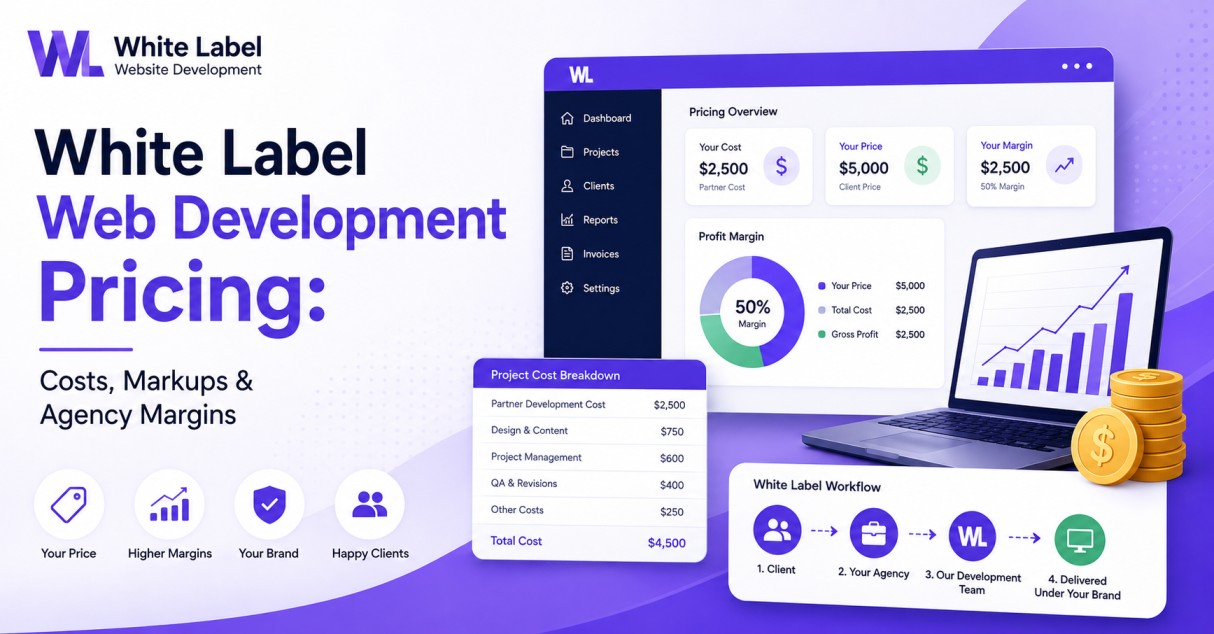
White label web development pricing can look simple from the outside: your agency pays a development partner one amount, charges the client a higher amount, and keeps the difference.
In practice, profitable white label pricing requires much more careful planning.
The developer's quote is only one part of your total delivery cost. Your agency may also spend time on sales, discovery, design, project management, client meetings, quality assurance, revision management, payment processing, launch coordination, and post-launch support. If those costs are ignored, a project that appears profitable on paper can produce very little actual margin.
For example, suppose a white label development partner charges your agency $2,500 for a website and you sell it to the client for $4,000.
It is tempting to think:
$4,000 − $2,500 = $1,500 profit
But if your agency spends another $900 on account management, design coordination, QA, meetings, and other internal costs, your actual project contribution before broader overhead falls to:
$4,000 − $3,400 = $600
That is why agencies need to understand not only white label web development cost, but also markup, gross margin, project margin, scope risk, recurring revenue, and the difference between revenue and profit.
This guide explains how white label web development pricing works, what affects costs, how agencies can calculate sustainable markups, how to protect margins, and how to build a pricing structure that can scale.
Table of Contents
- What Is White Label Web Development Pricing?
- How White Label Pricing Works
- What Does White Label Web Development Cost?
- What Determines the Cost of a White Label Website?
- Common White Label Pricing Models
- White Label Web Development Cost by Project Type
- How Agency Markups Work
- Markup vs Margin: The Difference Agencies Must Understand
- How to Calculate Your Real Project Cost
- How Much Should You Mark Up White Label Development?
- How to Calculate Agency Margins
- Example White Label Pricing Scenarios
- Pricing White Label WordPress Development
- Pricing White Label WooCommerce Development
- Pricing White Label Landing Pages
- Pricing Website Maintenance and Recurring Work
- Hourly vs Fixed-Price White Label Development
- Project-Based vs Retainer Pricing
- How Scope Creep Destroys Agency Margins
- How Revisions Should Be Priced
- Rush Fees and Urgent Projects
- Third-Party Software and Licensing Costs
- How to Price Project Management
- Should You Show Clients Your White Label Cost?
- White Label Pricing vs Hiring In-House
- White Label Pricing vs Freelancers
- How to Increase Margin Without Simply Raising Prices
- How to Build a White Label Pricing Structure
- Common White Label Pricing Mistakes
- Frequently Asked Questions
What Is White Label Web Development Pricing?
White label web development pricing is the commercial structure between an agency and an external development provider that performs work behind the agency's brand.
There are normally two prices involved.
The first is the partner price.
This is what the white label development provider charges your agency.
The second is the client price.
This is what your agency charges the end client for the complete service.
These two prices do not have to be the same, and they normally should not be.
Your agency is not simply forwarding a developer's invoice.
You may be adding significant value through:
- client acquisition
- strategy
- discovery
- communication
- project management
- design
- SEO
- quality assurance
- account management
- maintenance
- ongoing support
A white label project therefore has its own economics.
The development provider earns revenue by supplying production capacity.
Your agency earns revenue by packaging that capacity into a complete service and managing the customer relationship.
How White Label Pricing Works
Suppose a client contacts your agency for a new WordPress website.
After discovery, your agency sends the requirements to a white label WordPress development partner.
The development partner quotes:
$3,000
Your agency calculates that it will also spend approximately:
| Internal Cost | Estimated Cost |
|---|---|
| Sales and discovery | $300 |
| Project management | $600 |
| Design coordination | $500 |
| Internal QA | $300 |
| Client meetings and revisions | $400 |
| Miscellaneous project overhead | $200 |
| White label development | $3,000 |
| Estimated total delivery cost | $5,300 |
If the agency charges the client $5,500, the project leaves only $200 before broader company overhead and tax considerations.
If the agency charges $7,500, the economics are very different.
The correct price therefore cannot be calculated by looking only at the development invoice.
A better pricing formula is:
Client Price = External Production Cost + Internal Delivery Cost + Risk Allowance + Desired Profit
That formula gives agencies a much more realistic starting point.
What Does White Label Web Development Cost?
There is no universal cost for white label development because web projects vary dramatically.
A five-page informational website is not comparable to a custom ecommerce store.
A landing page built from an approved design is not comparable to a large website that requires strategy, UX, design, custom functionality, integrations, migration, and testing.
White label pricing depends on what the development partner is actually responsible for delivering.
For current service options, agencies can review our white label web development pricing.
The most important pricing principle is this:
Do not compare development quotes until you have compared the scopes behind those quotes.
A $1,500 quote and a $3,500 quote may not be pricing the same work.
One provider may include responsive development, QA, revisions, deployment, and project management.
Another may be quoting only the initial build.
What Determines the Cost of a White Label Website?
Several variables affect white label website development costs.
Website Size
Page count matters, but not every page has the same development complexity.
A website with 20 pages built from five reusable templates may require less work than a seven-page website where every page has a unique design and functionality.
The correct question is therefore not only:
How many pages are there?
It is also:
How many unique layouts, components, and functional requirements are there?
Design Complexity
A relatively simple corporate layout is different from a heavily customized design containing:
- advanced animations
- custom transitions
- interactive sections
- unusual navigation
- dynamic visual effects
- highly customized responsive behavior
Greater design complexity generally creates additional frontend work and additional QA requirements.
CMS
The technology used affects pricing.
Projects may involve:
- WordPress
- WooCommerce
- custom CMS development
- headless architectures
- SaaS platforms
- static websites
- other frameworks or platforms
The appropriate technology depends on the project requirements.
Custom Functionality
Custom features can significantly increase development cost.
Examples include:
- user accounts
- dashboards
- membership systems
- subscriptions
- calculators
- booking systems
- advanced search
- custom filtering
- directories
- document uploads
- custom workflows
- API integrations
A small feature in a client's description can represent significant development work.
Ecommerce
Ecommerce websites usually require more extensive testing and configuration than simple marketing websites.
Potential requirements include:
- product setup
- product variations
- cart
- checkout
- payments
- taxes
- shipping
- discount codes
- customer accounts
- transactional emails
- inventory
- third-party integrations
For these projects, agencies can use white label WooCommerce development.
Content Migration
Moving content from an old website to a new website may require substantial work.
Migration complexity depends on:
- number of pages
- posts
- products
- users
- media files
- custom fields
- database structure
- URL changes
Automated migration is not always possible.
Integrations
Integrations can increase complexity considerably.
A website may need to connect with:
- CRM systems
- payment providers
- email marketing tools
- booking software
- ERP systems
- accounting software
- external databases
- proprietary APIs
The cost depends on the quality of the third-party API, available documentation, authentication requirements, testing requirements, and error-handling complexity.
Responsive Requirements
Modern websites must work across different screen sizes.
However, responsive complexity varies.
A simple design may adapt easily.
A highly customized desktop interface may require significant mobile rethinking.
SEO Requirements
SEO-friendly development may involve:
- crawlable architecture
- editable metadata
- redirect planning
- structured heading hierarchy
- internal linking
- schema implementation
- canonical handling
- sitemap configuration
- performance considerations
For agencies where organic search matters, SEO-friendly web development should be considered during development rather than added after launch.
Timeline
Urgency can affect pricing.
If a project normally requires three weeks but the client demands completion in one week, the development provider may need to:
- rearrange schedules
- assign additional resources
- work outside normal hours
- delay other projects
Rush pricing compensates for those operational costs.
Common White Label Pricing Models
White label development companies can use different pricing structures.
| Pricing Model | How It Works | Best For |
|---|---|---|
| Fixed project | One agreed price for defined scope | Clearly scoped projects |
| Hourly | Agency pays for time used | Flexible or uncertain work |
| Dedicated resource | Developer/team allocated for a period | High-volume agencies |
| Monthly retainer | Recurring payment for capacity | Ongoing development |
| Maintenance plan | Monthly recurring technical service | Post-launch support |
| Bulk/project volume | Pricing based on recurring volume | Agencies with predictable demand |
No single pricing model is best for every agency.
White Label Web Development Cost by Project Type
Exact prices vary by provider, technology, complexity, geography, timeline, and scope.
It is therefore more useful to understand the relative cost structure than to assume every provider should fit the same fixed price.
| Project Type | Relative Complexity | Major Cost Drivers |
|---|---|---|
| Landing page | Low–Medium | design, responsive build, forms, tracking |
| Small business website | Low–Medium | page templates, CMS, content |
| Custom marketing website | Medium | custom UI, components, animation |
| WordPress website | Medium | theme/build system, plugins, custom functionality |
| Ecommerce website | Medium–High | products, checkout, payment, shipping |
| Membership website | High | authentication, access rules, billing |
| Directory website | High | listings, search, filters, user accounts |
| Custom web application | Very High | application logic, database, APIs, permissions |
Agencies should resist the temptation to package fundamentally different projects into the same fixed-price bucket.
How Agency Markups Work
A markup is the amount added to your cost when determining your selling price.
Suppose your development partner charges:
$2,000
If you apply a 50% markup:
$2,000 × 50% = $1,000 markup
Your selling price becomes:
$3,000
The formula is:
Selling Price = Cost × (1 + Markup Percentage)
For a 50% markup:
$2,000 × 1.50 = $3,000
For a 100% markup:
$2,000 × 2.00 = $4,000
However, markup alone does not tell you your margin.
That distinction is critical.
Markup vs Margin: The Difference Agencies Must Understand
Markup and margin are not the same thing.
Suppose a project costs you:
$2,000
and you sell it for:
$4,000
Your markup is:
100%
because you added another $2,000 to a $2,000 cost.
But your gross margin percentage is:
50%
because the $2,000 gross profit represents half of your $4,000 selling price.
The margin formula is:
Margin = (Selling Price − Cost) ÷ Selling Price × 100
So:
($4,000 − $2,000) ÷ $4,000 × 100 = 50%
This creates a common agency pricing mistake.
Someone may say:
"We need a 50% margin, so let's add 50% to our cost."
That does not produce a 50% margin.
If cost is $2,000 and you add 50%, the selling price becomes $3,000.
Margin is:
($3,000 − $2,000) ÷ $3,000 = 33.3%
To achieve a 50% gross margin on a $2,000 cost, the selling price must be $4,000.
Markup and Margin Conversion Examples
| Cost | Markup | Selling Price | Gross Margin |
|---|---|---|---|
| $2,000 | 20% | $2,400 | 16.7% |
| $2,000 | 25% | $2,500 | 20% |
| $2,000 | 50% | $3,000 | 33.3% |
| $2,000 | 75% | $3,500 | 42.9% |
| $2,000 | 100% | $4,000 | 50% |
| $2,000 | 150% | $5,000 | 60% |
Understanding this table can prevent major pricing mistakes.
How to Calculate Your Real Project Cost
The white label provider's invoice is not your entire cost.
Consider the full project.
Suppose your partner charges:
$3,000
Your agency also spends:
| Cost Category | Cost |
|---|---|
| Development partner | $3,000 |
| Sales/discovery | $400 |
| Project management | $700 |
| QA | $300 |
| Client meetings | $300 |
| Design coordination | $500 |
| Software/licenses absorbed by agency | $200 |
| Estimated revision management | $300 |
| Real delivery cost | $5,700 |
If you sell the project for $6,000, you are not making $3,000.
You are making approximately:
$300 before broader overhead
That project is operating on an extremely thin cushion.
Instead of using:
Partner Cost → Markup → Client Price
use:
Total Delivery Cost → Target Margin → Client Price
This is a much more reliable model.
How Much Should You Mark Up White Label Development?
There is no universal markup that every agency should use.
The right number depends on how much value and responsibility your agency adds.
Consider an agency that only brings the lead and sends everything else to a partner.
Its internal cost may be relatively low.
Now consider an agency that handles:
- discovery
- strategy
- UX
- client management
- copy coordination
- SEO
- QA
- weekly meetings
- revisions
- training
- post-launch support
The second agency needs more margin because it is delivering substantially more work.
A sustainable price should cover:
production + internal labor + overhead + risk + profit
not simply an arbitrary multiplier.
How to Calculate Agency Margins
Suppose your final client price is:
$10,000
Your total project delivery costs are:
$6,000
Gross contribution:
$4,000
Gross project margin:
$4,000 ÷ $10,000 = 40%
Now imagine your costs increase to $7,500 because of excessive revisions.
Your margin becomes:
$2,500 ÷ $10,000 = 25%
This is why project management and scope control are not administrative details.
They directly affect profitability.
Example White Label Pricing Scenarios
Example 1: Small Business Website
Suppose your partner cost is:
$1,800
Internal agency costs:
$1,000
Total delivery cost:
$2,800
Client price:
$5,000
Gross project contribution:
$2,200
Gross project margin:
44%
This can be a healthy structure if the project remains within scope.
Example 2: Custom WordPress Website
Partner development:
$4,000
Design:
$1,500
Project management:
$1,000
QA and revisions:
$750
Total estimated delivery cost:
$7,250
Client price:
$12,000
Gross contribution:
$4,750
Gross margin:
39.6%
Again, this is before broader overhead and tax.
Example 3: Poorly Scoped Project
Partner quote:
$3,000
Agency client price:
$5,000
Initially, the agency expects:
$2,000 difference
Then the client requests:
- three additional pages
- custom filtering
- another revision round
- CRM integration
Additional development cost:
$1,200
Extra agency management:
$400
Total project cost rises from $3,000 to:
$4,600
Now the $5,000 project generates only:
$400 before wider overhead
The problem was not necessarily the white label partner.
The problem was pricing a vague scope.
Pricing White Label WordPress Development
WordPress is one of the most common platforms in agency outsourcing.
White label WordPress development can include:
- new builds
- theme development
- page builder implementation
- redesigns
- migrations
- plugin configuration
- custom functionality
- integrations
- performance work
WordPress pricing depends heavily on whether the project uses:
- existing theme + minor customization
- or
- custom design + custom components + functionality
These are very different scopes.
Premium plugin licensing must also be considered.
Questions agencies should settle before quoting include:
- Who purchases licenses?
- Who renews them?
- Does the agency retain the license?
- Does the client need their own license?
- What happens if the agency relationship ends?
Software licensing should never be assumed.
Pricing White Label WooCommerce Development
WooCommerce projects typically contain more variables.
The scope may include:
- product setup
- variations
- categories
- checkout customization
- payments
- shipping
- taxes
- coupons
- customer accounts
- subscriptions
- third-party integrations
An apparently simple request such as:
"We need an online shop."
is not sufficient for pricing.
A store selling five simple products with one payment gateway is very different from a store with:
- hundreds of products
- variable products
- subscriptions
- custom shipping rules
- wholesale pricing
- external inventory integration
Agencies should conduct deeper discovery before requesting a white label WooCommerce development estimate.
Pricing White Label Landing Pages
Landing pages can be easier to standardize.
A landing-page pricing model might depend on:
- whether design is supplied
- page length
- responsive complexity
- forms
- CRM integration
- analytics
- conversion tracking
- animation
- A/B testing requirements
Agencies running PPC campaigns can package white label landing page design and development with advertising services.
That creates a stronger commercial offer than selling development in isolation.
For example:
Campaign setup + landing page + tracking + optimization
may be more valuable to the client than:
Landing page development
alone.
Pricing Website Maintenance and Recurring Work
One of the strongest opportunities in white label development is recurring revenue.
A website does not stop requiring technical attention after launch.
Maintenance may include:
- backups
- updates
- security monitoring
- uptime monitoring
- technical fixes
- content changes
- performance checks
- ongoing development
With white label website maintenance, the agency can sell recurring support while the partner handles agreed technical tasks.
Suppose the partner charges:
$100 per month
The agency sells a care plan for:
$250 per month
The difference is not automatically $150 in profit.
The agency may still handle:
- client communication
- reporting
- billing
- support requests
- account management
But recurring pricing has advantages.
Instead of repeatedly selling a completely new project, the agency builds recurring monthly revenue from existing customers.
Website Build + Recurring Revenue Model
Consider a client who purchases:
| Service | Client Price |
|---|---|
| Website development | $6,000 one time |
| Maintenance | $250/month |
| SEO | $1,500/month |
| Landing page support | $400/month |
| Recurring monthly value | $2,150/month |
The initial website becomes an entry point into a broader agency relationship.
That is one reason agencies should avoid evaluating website projects based only on one-time development margin.
Customer lifetime value can be much more important.
Hourly vs Fixed-Price White Label Development
Both models can work.
Fixed Pricing
A fixed-price quote is usually best when requirements are clearly defined.
For example:
Build 10-page WordPress website from approved Figma designs for $X.
The advantage is predictable cost.
The risk is scope ambiguity.
If the scope changes significantly, the price must also change.
Hourly Pricing
Hourly billing can work well for:
- bug fixes
- maintenance
- uncertain requirements
- ongoing technical support
- legacy projects
- custom development
The advantage is flexibility.
The disadvantage is less predictable cost.
For client-facing agency projects, one strategy is:
Partner bills agency hourly → Agency sells client a defined block or retainer
But the agency should track utilization carefully.
Project-Based vs Retainer Pricing
Project-based pricing works when work has a clear beginning and end.
Retainers work when development demand continues.
An agency may move through three stages:
Stage 1: Occasional project
Pay the partner per project.
Stage 2: Regular volume
Negotiate recurring capacity.
Stage 3: Consistent high volume
Use a dedicated or semi-dedicated team structure.
The best model depends on utilization.
Paying for a full-time dedicated resource makes little sense if the agency only has 30 hours of development work each month.
Likewise, constantly quoting dozens of tiny tasks individually can become inefficient when workload is predictable.
How Scope Creep Destroys Agency Margins
Scope creep occurs when project requirements expand after pricing has already been agreed.
For example, the proposal says:
10-page website
The client later asks for:
- three additional service pages
- resource directory
- booking system
- multilingual support
If the agency accepts these additions without changing the price, margin decreases every time.
The solution is not saying "no" to clients.
The solution is distinguishing:
included revision
from
additional scope
A change-request process should identify:
New Requirement → Technical Estimate → Additional Price → Approval → Development
This keeps the relationship professional.
How Revisions Should Be Priced
Uncontrolled revisions are another common profitability problem.
Suppose a project includes:
Two revision rounds
That should mean two consolidated review cycles, not unlimited changes for an unlimited period.
The agency should establish:
- what counts as a revision
- how feedback is submitted
- how many rounds are included
- what happens after included rounds
- what qualifies as new scope
A revision changes something that is already within the agreed requirement.
A change request adds or materially changes the requirement itself.
That distinction should remain clear.
Rush Fees and Urgent Projects
Urgent projects can justify different pricing.
Suppose normal delivery is four weeks.
The client wants one week.
The agency and development partner may need to:
- prioritize the project
- reschedule existing work
- assign additional developers
- extend working hours
- increase project management intensity
That has a cost.
A rush fee is therefore not simply charging more because a client is in a hurry.
It compensates for the operational impact of prioritizing the project.
Third-Party Software and Licensing Costs
Website development frequently depends on software the developer does not own.
Examples include:
- premium WordPress plugins
- premium themes
- fonts
- stock assets
- APIs
- SaaS subscriptions
- email delivery services
- booking platforms
- payment services
These costs should be identified during scoping.
Questions include:
- Does the agency pay?
- Does the client pay?
- Is the cost included in the quote?
- Is it recurring?
- Who owns the account?
- What happens when the project ends?
Ignoring recurring licenses can create long-term support problems.
How to Price Project Management
Project management is real work.
Agencies often underprice it because it does not look like development.
However, an account manager may spend hours:
- preparing meetings
- reviewing progress
- answering client emails
- documenting feedback
- coordinating design
- communicating with developers
- reviewing staging sites
- organizing revisions
- managing launch
If a project requires 20 hours of internal management and the agency ignores those hours, the calculated margin is misleading.
Project management should be included in your project economics.
Should You Show Clients Your White Label Cost?
In a typical white label relationship, the partner's internal pricing is part of the agency's supplier relationship rather than the end client's pricing model.
The client is purchasing the agency's complete service.
Consider a restaurant.
The customer does not normally receive a breakdown showing:
- ingredient cost
- kitchen labor
- rent allocations
- supplier margin
They pay for the finished service.
Similarly, an agency may provide:
- strategy
- project management
- development
- design
- QA
- account management
The client price reflects that total value.
However, agencies should comply with their own contracts and any client procurement or disclosure requirements.
White Label Pricing vs Hiring In-House
White label development and internal hiring have different cost structures.
An internal developer can involve:
- salary
- payroll costs
- benefits
- equipment
- software
- recruitment
- management
- training
- paid downtime
Those costs continue even when development demand falls.
White label development can convert some development spending into a variable cost.
If you have more projects, you purchase more production.
If you have fewer projects, your external development spend may decline.
However, white label development also carries supplier margin.
If your agency has stable, predictable, high utilization for a particular technical role, internal hiring may eventually make more financial sense.
The correct comparison is not:
$X/hour freelancer vs $Y/hour employee
It is:
total cost of reliable capacity under each model
White Label Pricing vs Freelancers
Freelancers can sometimes offer lower pricing than a structured white label team.
But agencies should compare more than hourly rates.
| Factor | Freelancer | White Label Team |
|---|---|---|
| Individual hourly rate | Often lower | May be higher |
| Backup capacity | Limited | Potentially greater |
| QA | Depends on person | May be dedicated |
| Project management | Varies | Often structured |
| Multiple technologies | Limited by individual | Broader team possible |
| Concurrent projects | Limited | Potentially higher |
| Continuity | Individual dependency | Team redundancy possible |
A $30/hour developer is not necessarily cheaper than a $60/hour provider if the first requires double the management and rework.
Compare total delivery cost.
How to Increase Margin Without Simply Raising Prices
Higher prices can improve margins, but price increases are not the only option.
Operational efficiency matters.
Suppose your agency currently spends 15 hours managing every website.
Better templates and standardized processes reduce that to eight hours.
If quality remains equal or improves, your delivery cost drops.
Margin increases without changing the client price.
Agencies can improve profitability by:
- improving discovery
- standardizing scopes
- using reusable proposal templates
- collecting content earlier
- consolidating feedback
- using QA checklists
- standardizing technology
- reducing unnecessary meetings
- creating repeatable launch procedures
- improving partner communication
Efficient agencies can sometimes outperform competitors even at similar client prices.
Productize Your White Label Services
One way to simplify pricing is productization.
Instead of quoting every project from zero, create defined packages.
For example:
Starter Website
Defined number of page templates, standard functionality, responsive development, one contact form, defined revisions.
Growth Website
More templates, additional functionality, blog, integrations, expanded revision allowance.
Ecommerce Website
WooCommerce setup, product templates, checkout, payment setup, defined ecommerce requirements.
The exact inclusions should match your agency's market.
Productization works best when projects are genuinely similar.
Do not force custom software requirements into a standardized website package.
Build a Minimum Project Price
Agencies should understand the minimum project size worth accepting.
Suppose every website requires at least:
- sales effort
- discovery
- project setup
- communication
- QA
- invoicing
- launch management
Those costs exist whether the project is worth $1,000 or $10,000.
Very small projects can therefore have disproportionate management costs.
A minimum project price protects your team from filling its schedule with low-value work that generates little contribution.
Build a Risk Allowance Into Pricing
Not every project proceeds perfectly.
There may be:
- additional meetings
- minor unexpected technical problems
- delayed content
- additional QA
- difficult integrations
- extra coordination
You should not intentionally create vague scopes.
But your pricing model can include an appropriate allowance for predictable operational uncertainty.
This is different from padding invoices arbitrarily.
It is recognizing that delivery has risk.
How to Build a White Label Pricing Structure
A scalable pricing structure begins with knowing your costs.
Start with:
1. External development cost
What does your partner charge?
Then calculate:
2. Internal labor cost
How much does your agency spend managing delivery?
Then add:
3. Project-specific costs
Software, design, content, licenses, contractors.
Then account for:
4. Risk
How predictable is the scope?
Finally:
5. Desired contribution
What must the project generate to justify occupying agency resources?
Your pricing formula becomes:
External Cost + Internal Cost + Direct Expenses + Risk Allowance + Profit = Client Price
Example Agency Pricing Calculator
Suppose a project has:
| Component | Cost |
|---|---|
| White label development | $3,500 |
| Design | $1,000 |
| Project management | $750 |
| QA | $350 |
| Client communication | $300 |
| Software | $100 |
| Risk allowance | $500 |
| Total planned cost | $6,500 |
If the agency wants a 35% gross project margin, pricing cannot simply be:
$6,500 + 35%
That would produce:
$8,775
and a margin of only approximately 25.9%.
To calculate a selling price from desired margin:
Selling Price = Cost ÷ (1 − Desired Margin)
For a 35% margin:
$6,500 ÷ 0.65 = $10,000
So the appropriate selling price under that assumption would be approximately:
$10,000
This is why understanding margin mathematics matters.
Margin Pricing Formula
Use:
Selling Price = Total Cost ÷ (1 − Target Margin)
Examples:
| Total Cost | Target Margin | Required Selling Price |
|---|---|---|
| $3,000 | 20% | $3,750 |
| $3,000 | 30% | $4,286 |
| $3,000 | 40% | $5,000 |
| $3,000 | 50% | $6,000 |
| $5,000 | 30% | $7,143 |
| $5,000 | 40% | $8,333 |
| $5,000 | 50% | $10,000 |
This formula is much safer than randomly adding a percentage to partner cost.
What Is a Good Agency Margin?
There is no universal gross-margin percentage that every agency should target.
A sustainable margin depends on:
- agency overhead
- sales cost
- service complexity
- market position
- project risk
- staff cost
- utilization
- recurring revenue
- support obligations
A premium agency with a heavy strategy and account-management layer may need more contribution per project than a highly streamlined production-focused agency.
Instead of copying another company's percentage, calculate the economics of your own business.
A project is only attractive if its contribution makes sense after considering the resources it consumes.
Revenue Is Not Profit
This distinction is especially important when agencies begin scaling.
Suppose you sell:
10 websites × $8,000 = $80,000 revenue
That sounds impressive.
But suppose total delivery costs are:
10 × $7,000 = $70,000
Only $10,000 remains before company-wide expenses.
Compare that with:
6 websites × $8,000 = $48,000
with total delivery costs of:
6 × $4,500 = $27,000
That leaves $21,000 before broader expenses.
The second agency generates lower revenue but substantially more project contribution.
Growth without margin discipline can make an agency busier without making it healthier.
Why Cheap White Label Development Can Be Expensive
The lowest quote is not always the lowest cost.
Suppose Provider A charges:
$1,800
Provider B charges:
$2,800
Provider A looks cheaper.
But Provider A requires:
- six hours additional agency QA
- repeated follow-ups
- three rounds of bug fixes
- missed deadlines
- client-management recovery
If that adds $1,500 in internal cost, Provider A's effective cost becomes:
$3,300
Provider B may actually be cheaper.
Evaluate providers based on total cost of successful delivery, not invoice amount alone.
When to Negotiate Volume Pricing
Once an agency provides predictable project volume, supplier economics may change.
For example, it may become possible to standardize:
- technology
- project templates
- communication
- QA
- billing
- capacity planning
This reduces administrative cost for both parties.
At that point, agencies can discuss:
- volume pricing
- reserved capacity
- monthly retainers
- dedicated resources
- bundled maintenance
- faster estimation
However, do not demand volume discounts based on hypothetical future work.
Consistent volume creates genuine leverage.
How Recurring Revenue Changes Your Pricing Strategy
Imagine two agencies.
Agency A sells a website for:
$7,000
and never works with the client again.
Agency B sells the same website for:
$6,000
then sells:
$300/month maintenance
and:
$1,500/month SEO
If the client stays for a significant period, Agency B may generate much greater total customer value despite a lower initial website price.
That does not mean agencies should deliberately underprice websites.
It means pricing decisions should consider the entire customer relationship.
Common White Label Pricing Mistakes
The most frequent pricing problems tend to come from a small number of causes:
- Marking up only the development invoice while ignoring project management, QA, sales, revisions, and account management.
- Confusing markup with margin, leading agencies to believe a project is more profitable than it actually is.
- Quoting before technical scoping, especially when custom functionality is involved.
- Offering unlimited revisions without understanding how much production time they can consume.
- Absorbing change requests instead of repricing additional scope.
- Ignoring third-party licenses and recurring costs.
- Underpricing rush work that disrupts normal delivery.
- Choosing suppliers solely by hourly rate instead of total delivery efficiency.
- Failing to track actual project costs after completion.
- Using the same margin target for every project regardless of complexity and risk.
The solution is not simply charging more.
The solution is measuring more accurately.
Track Estimated Margin vs Actual Margin
After every project, compare:
- Estimated Partner Cost vs Actual Partner Cost
- Estimated Internal Hours vs Actual Hours
- Estimated Revision Time vs Actual Revision Time
- Estimated Gross Margin vs Actual Gross Margin
This creates valuable historical data.
After 20 projects, you may discover that:
- ecommerce projects consistently require more QA
- certain clients require more account management
- certain project types produce better margins
- some service packages are underpriced
- some development partners require more management
- content delays regularly create scheduling problems
Your pricing model can then improve using your own business data.
Should Agencies Publish Their White Label Pricing?
There are advantages and disadvantages.
Public pricing can:
- prequalify leads
- reduce repetitive sales questions
- establish expectations
- improve transparency
But fixed public pricing becomes difficult when project complexity varies dramatically.
A practical alternative is:
starting prices
or:
defined packages + custom quote for advanced requirements
Agencies looking for partner pricing can review our pricing page and discuss specific requirements before committing to a project.
How to Protect Margins Before Development Starts
Most margin problems begin before the first line of code is written.
A strong pre-production process should ensure that:
- requirements are documented
- major functionality is understood
- designs are ready or design responsibility is defined
- page count is established
- content responsibility is clear
- integration requirements are known
- revisions are defined
- timeline is realistic
- third-party costs are identified
- launch responsibilities are clear
Our white label development process explains how structured project delivery can reduce ambiguity between discovery and launch.
White Label Pricing and Confidentiality
Price is not the only term that matters when choosing a development partner.
A reliable white label relationship may also require:
- confidentiality
- client protection
- restricted direct contact
- secure credential handling
- intellectual-property clarity
The cheapest supplier can create significant commercial risk if those boundaries are unclear.
Our NDA and confidentiality information explains how confidentiality fits into white label engagements.
Choosing a White Label Partner Based on Value, Not Price Alone
When comparing providers, consider the entire service.
Ask whether the partner provides:
- reliable technical delivery
- appropriate QA
- clear communication
- responsive development
- realistic timelines
- revision processes
- launch support
- ongoing maintenance
- confidentiality
- capacity for growth
You can also review a provider's previous work before making a decision.
See our white label development portfolio for examples of completed projects.
White Label Website Builder FAQs
Need production capacity, not another builder?
We build SEO-ready websites under your brand — NDA friendly, dedicated PM, delivered on schedule.
Get a free white label quote