
What Is White Label Web Development? Complete 2026 Guide
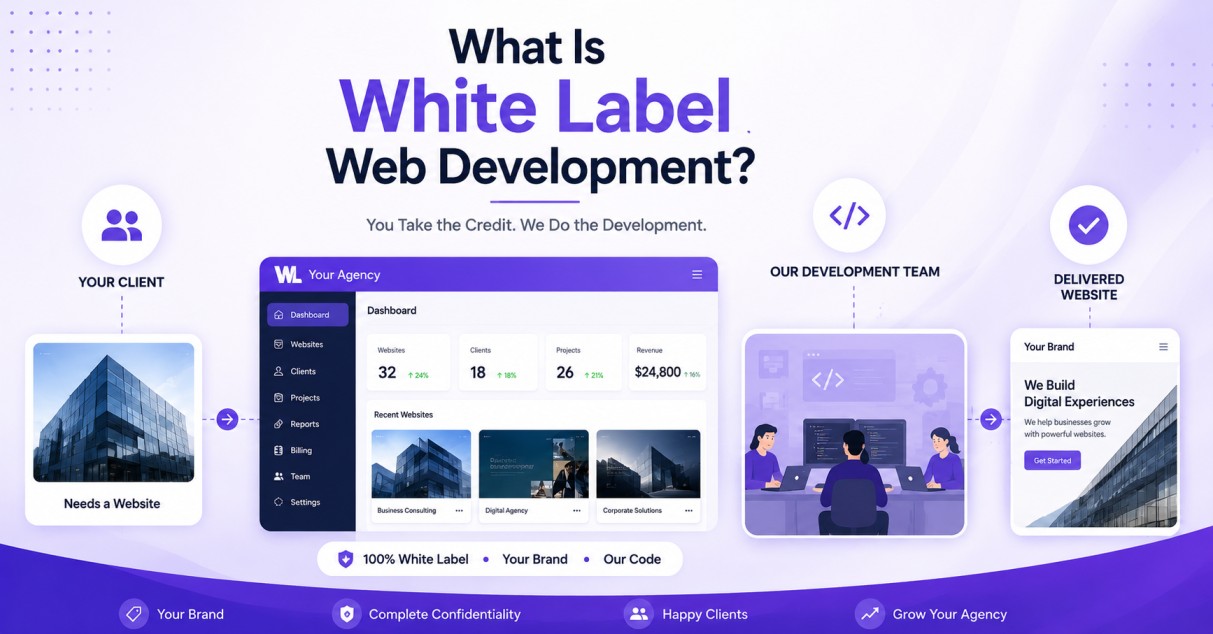
What Is White Label Web Development? A Complete Guide for Agencies
White label web development is a business model where one company builds websites or handles development work on behalf of another company, while the finished work is delivered under the purchasing company's brand.
In a typical arrangement, a digital marketing agency, SEO company, design studio, consultant, or freelancer sells a website project to its client. Instead of completing every technical task internally, the agency sends the project to a white label web development partner.
The development partner works behind the scenes.
The agency remains the face of the project, manages the client relationship, and delivers the finished website under its own brand.
In simple terms:
Your agency gets the client → your white label partner builds the website → you deliver it under your brand.
This model allows agencies to offer professional web development without necessarily hiring a full internal development department.
But white label development is more than simply sending a project to a random freelancer.
A proper white label relationship normally requires clear project ownership, confidentiality, defined communication channels, quality assurance, predictable delivery processes, and an agreement about how the development partner interacts—or does not interact—with the end client.
This guide explains what white label web development is, how it works, what services can be white labeled, how agencies make money from it, what it can cost, how it compares with freelancers and in-house development, and what to look for when choosing a white label development partner.
Table of Contents
- What Is White Label Web Development?
- A Simple White Label Development Example
- How Does White Label Web Development Work?
- Who Uses White Label Web Development?
- What Web Development Services Can Be White Labeled?
- White Label Web Development vs Outsourcing
- White Label Development vs Freelancers
- White Label Development vs In-House Developers
- Benefits of White Label Web Development
- Potential Risks and Disadvantages
- How Agencies Make Money With White Label Development
- How Much Does White Label Web Development Cost?
- NDA, Confidentiality and Client Protection
- Who Owns the Website and Code?
- How to Choose a White Label Development Partner
- Red Flags to Watch For
- When Should an Agency Use White Label Development?
- How to Start White Labeling Web Development
- Frequently Asked Questions
Quick Answer: What Is White Label Web Development?
White label web development is when an external developer or development company builds websites for another agency to sell and deliver under its own brand.
The agency usually owns the client relationship, handles sales and account management, and determines what it charges the client. The white label development partner handles agreed technical work behind the scenes.
For example, an SEO agency may sell a $5,000 website project to a client and hire a white label development partner to complete the development portion of that project. The client continues working with the SEO agency, while the development team operates in the background according to the agreed white-label arrangement.
The model can help agencies expand their services and delivery capacity without immediately adding permanent development headcount.
Who Is This Guide For?
White label web development is particularly relevant if you operate a:
- SEO agency
- digital marketing agency
- web design agency
- branding studio
- advertising agency
- PR agency
- freelance design business
- consulting company
- software company
- hosting company
It can also be useful for established development agencies experiencing temporary capacity problems.
The common denominator is simple:
You have access to clients or projects, but you do not always want to perform every development task internally.
What Is White Label Web Development?
The easiest way to understand white label development is to separate the three parties involved.
1. The End Client
This is the business that needs the website.
For example:
ABC Dental Clinic
2. The Agency
The agency sells and manages the project.
For example:
Growth Marketing Agency
3. The White Label Development Partner
The development company performs agreed technical work behind the scenes.
For example:
Development Partner
The relationship might look like this:
ABC Dental Clinic
       ↓
Growth Marketing Agency
       ↓
White Label Development Partner
From the client's perspective, the agency remains responsible for delivering the project.
Behind the scenes, however, the agency has access to an external development team.
Suggested filename: how-white-label-web-development-works.webp
Alt text: Diagram showing how white label web development works between a client, agency and development partner
A Simple White Label Development Example
Imagine that you run an SEO agency.
Your core team consists of:
- SEO strategists
- content writers
- link builders
- account managers
One of your existing clients asks:
"Can you redesign and develop our website as well?"
You now have several options.
You could decline the project.
You could refer the client to another development company.
You could hire developers.
You could try to coordinate several freelancers.
Or you could use a white label web development service.
With the white label model, your agency can remain responsible for the overall engagement while a specialist development team handles the website production.
A simplified workflow could be:
Client requests website → Agency scopes project → White label partner reviews technical requirements → Agency provides proposal → Development begins → Agency reviews work → Client provides feedback → Revisions are completed → Website launches
The important point is that your agency remains at the center of the relationship.
How Does White Label Web Development Work?
Although every partnership is different, a structured white label project commonly follows several stages.
Step 1: Your Agency Wins the Client
Your agency handles:
- marketing
- sales
- discovery
- client relationship
- account management
You identify that the client requires website development.
Step 2: Requirements Are Collected
The project needs to be defined before development begins.
Typical requirements include:
- number of pages
- design requirements
- CMS
- functionality
- forms
- integrations
- ecommerce requirements
- responsive requirements
- content availability
- SEO requirements
- launch date
Weak requirements create problems regardless of whether development is completed internally or externally.
Step 3: The White Label Partner Reviews the Scope
The development partner evaluates the technical requirements.
They may identify:
- development complexity
- required technologies
- integrations
- potential technical limitations
- estimated delivery time
- dependencies
- expected development effort
The agency can then prepare its final client proposal.
Step 4: The Agency Sets the Client Price
One of the major characteristics of white labeling is that the agency generally controls its own commercial relationship with the end client.
For example:
Development partner cost: $2,000
Agency client price: $4,000
The $2,000 difference should not automatically be interpreted as pure profit.
The agency may still be responsible for:
- sales
- project management
- meetings
- revisions
- content
- strategy
- quality assurance
- client support
- taxes
- software
- marketing
- other overhead
But white labeling allows the agency to create its own pricing structure instead of merely collecting a referral commission.
Step 5: Development Begins
The partner completes the agreed work.
Depending on the arrangement, this may include:
- frontend development
- backend development
- CMS configuration
- responsive implementation
- integrations
- ecommerce
- testing
- performance optimization
The partner may work inside the agency's project management system or follow an agreed external workflow.
Step 6: Internal QA
Before presenting the website to the client, both development QA and agency-level review may be necessary.
Typical checks include:
- desktop responsiveness
- mobile responsiveness
- tablet layouts
- forms
- navigation
- links
- images
- content
- browser compatibility
- basic accessibility
- page speed
- tracking
- SEO implementation
- functionality
A reliable white label process should not treat the end client as the QA department.
Step 7: Client Feedback
Your agency collects feedback from the client.
That feedback is converted into actionable development tasks and passed to the development team.
This communication layer is extremely important.
Unstructured feedback creates scope creep and delays.
Step 8: Revisions
The development partner completes agreed revisions.
A professional engagement should define:
- number of revision rounds
- what counts as a revision
- what constitutes new scope
- who approves changes
- how additional work is priced
Step 9: Launch
After final approval, the website is deployed.
The exact launch process depends on the technology and hosting environment.
Step 10: Ongoing Support
The relationship does not necessarily end after launch.
Clients may require:
- security updates
- backups
- plugin updates
- content changes
- bug fixes
- performance monitoring
- landing pages
- feature development
This creates another opportunity for agencies to generate recurring revenue.
If your agency does not want to maintain client websites internally, white label website maintenance can extend the same behind-the-scenes model beyond the initial build.
What Does the Client See?
This depends on the agreement.
In a strict white label arrangement, the client primarily interacts with your agency.
Your agency may handle:
- proposals
- contracts
- invoices
- emails
- meetings
- project updates
- revisions
- delivery
The development partner operates behind the scenes.
That separation is one of the primary differences between white labeling and simply referring a customer to another vendor.
Important: The exact level of partner visibility should be explicitly agreed before the project begins. Do not assume every company uses the same definition of "white label."
Who Uses White Label Web Development?
White label development is useful across several types of businesses.
SEO Agencies
SEO agencies frequently discover website problems they cannot solve with optimization alone.
Examples include:
- poor website architecture
- slow performance
- outdated themes
- technical errors
- weak landing pages
- broken mobile layouts
- difficult CMS setups
Instead of sending the client elsewhere, an SEO agency can potentially add web development to its offering.
Our white label services for SEO agencies are structured around this type of delivery model.
Digital Marketing Agencies
Marketing agencies often manage:
- PPC
- SEO
- social media
- email marketing
- content
Every one of those channels eventually sends users somewhere.
Usually, that destination is a website or landing page.
Development capability therefore complements marketing services naturally.
Branding and Design Agencies
A branding studio may be excellent at:
- visual identity
- UI
- UX
- graphic design
- brand strategy
but lack internal developers.
A white label partner can convert approved designs into functional websites.
Freelancers
A freelance designer may receive larger projects than one person can deliver efficiently.
Rather than rejecting them, the freelancer can create a small virtual delivery team through specialist partners.
Web Development Agencies
Even development companies can use white label partners.
Why?
Capacity is rarely perfectly predictable.
One month may have five active projects.
The next may have fifteen.
White labeling can provide overflow capacity without requiring every demand spike to trigger permanent hiring.
What Web Development Services Can Be White Labeled?
White label development is not limited to one type of website.
White Label Website Design
Agencies can outsource some or all of the design and implementation process.
This can include:
- wireframes
- page layouts
- responsive design
- UI implementation
- conversion-oriented pages
Explore our white label website design services.
White Label WordPress Development
WordPress projects are a common white-label use case.
Work can include:
- WordPress installation
- custom themes
- theme customization
- page builders
- custom functionality
- plugin configuration
- migrations
- performance improvements
- responsive development
For WordPress-specific projects, see our white label WordPress development service.
White Label WooCommerce Development
Ecommerce projects introduce additional requirements such as:
- product architecture
- cart
- checkout
- payment gateways
- shipping
- taxes
- customer accounts
- order management
- integrations
These projects can be outsourced through white label WooCommerce development.
White Label Landing Page Development
SEO and paid advertising agencies frequently need landing pages.
These might support:
- Google Ads
- Meta Ads
- lead generation
- product launches
- local SEO
- email campaigns
- service campaigns
Agencies can outsource these builds through white label landing page design and development.
SEO-Friendly Web Development
A visually attractive website can still create problems for an SEO agency if the development ignores:
- crawlability
- heading hierarchy
- metadata controls
- internal linking
- structured data
- redirects
- indexation
- page performance
Development and SEO therefore need to work together.
Our SEO-friendly web development service focuses specifically on that intersection.
Website Audits and Technical Fixes
Not every project requires a rebuild.
Sometimes the correct starting point is identifying:
- performance problems
- technical errors
- broken functionality
- UX issues
- mobile problems
- SEO implementation problems
A white label website audit can help agencies assess an existing website before recommending larger development work.
White Label Web Development vs Outsourcing
The two terms overlap, but they should not always be treated as identical.
White label development is generally a specific form of outsourcing structured around the purchasing company's brand and client relationship.
| Area | White Label Development | General Outsourcing |
|---|---|---|
| External team performs work | Yes | Yes |
| Agency branding | Central to model | Not necessarily |
| Partner visibility | Usually restricted | May be visible |
| Direct client relationship | Usually retained by agency | Varies |
| Confidentiality | Often formalized | Varies |
| Reselling | Core use case | Not always |
| Long-term partnership | Common | May be project-based |
The distinction becomes important when client ownership matters.
If you simply introduce another developer to your customer, you may be outsourcing or referring work.
If the development company operates as a behind-the-scenes extension of your agency under an agreed white-label structure, you are much closer to a true white label model.
White Label Development vs Freelancers
Freelancers can be excellent.
The question is not whether freelancers are good or bad.
The question is whether the delivery model fits your agency.
| Factor | White Label Agency/Team | Individual Freelancer |
|---|---|---|
| Capacity | Potentially multiple developers | Usually one person |
| Project management | Often structured | Varies |
| QA resources | Can be dedicated | Often self-managed |
| Specialist availability | Multiple skill sets possible | Limited to individual |
| Scalability | Generally higher | Limited by personal capacity |
| Continuity | Team can provide redundancy | Individual dependency |
| Cost | May be higher | Can be lower |
| Flexibility | High | High |
A freelancer may be ideal for occasional, specialized work.
A structured white label team may make more sense when you need predictable capacity across multiple client projects.
White Label Development vs In-House Developers
This is one of the biggest strategic decisions for a growing agency.
In-House Development
An internal developer provides:
- direct communication
- deeper company familiarity
- consistent availability
- tighter cultural integration
But the agency also assumes:
- salary
- benefits
- recruitment
- equipment
- training
- management
- utilization risk
If project volume falls, payroll usually does not disappear.
White Label Development
White labeling can turn at least part of development delivery into a variable project cost.
You buy capacity when needed.
But you also give up some direct control and must build a reliable external workflow.
Comparison
| Factor | White Label Partner | In-House Team |
|---|---|---|
| Recruitment | Minimal | Required |
| Fixed payroll | Lower | Higher |
| Scale up/down | Easier | Harder |
| Direct control | Moderate | High |
| Team integration | Requires process | Strong |
| Specialist access | Potentially broad | Depends on hires |
| Idle capacity risk | Lower | Higher |
| Long-term internal knowledge | Lower | Higher |
Neither approach is automatically superior.
Many mature agencies use both.
They maintain a core internal team and use trusted partners for:
- overflow
- specialized projects
- temporary capacity
- services outside their core stack
Benefits of White Label Web Development
1. Expand Your Services Without Building Every Capability Internally
Suppose your agency currently sells only:
- SEO
- PPC
- content
Clients may also need:
- websites
- landing pages
- ecommerce
- maintenance
A white label partnership allows you to explore those revenue opportunities without immediately creating an entire development department.
2. Take On More Projects
Capacity constraints force agencies to reject otherwise profitable work.
A scalable development partner can provide additional production capacity during busy periods.
3. Reduce Hiring Pressure
Hiring should be driven by long-term business requirements—not panic because three websites arrived simultaneously.
White labeling provides another capacity option.
4. Convert Some Fixed Costs Into Variable Costs
An internal development team creates ongoing expenses.
Project-based white label arrangements can allow development costs to track project volume more closely.
That can be particularly useful for agencies with irregular demand.
5. Access Specialized Skills
One client needs WordPress.
Another needs WooCommerce.
Another needs performance optimization.
Another needs a complex integration.
Maintaining every possible specialist internally can be difficult.
A broader development team can provide access to multiple skill sets.
6. Keep the Client Relationship
This is one of the biggest commercial advantages.
Instead of telling a client:
"We don't do websites. Talk to another company."
you can potentially say:
"Yes, we can handle the website."
Your agency remains responsible for the service relationship.
7. Create Additional Revenue Streams
Website projects can lead to recurring services including:
- hosting
- maintenance
- SEO
- content
- CRO
- landing pages
- ecommerce support
A single project can therefore become a longer-term account.
8. Scale More Flexibly
An agency may need one developer this month and several developers during a major launch cycle.
External production capacity can make those fluctuations easier to manage.
Potential Risks and Disadvantages
White label development is not automatically successful.
A poor partner can create more problems than they solve.
Communication Risk
If your client tells you one thing and your team tells the developer something different, mistakes multiply.
You need a clear communication process.
Quality Control
Your brand appears on the finished product.
That means the partner's mistake becomes your agency's problem.
QA cannot be optional.
Missed Deadlines
If the development partner misses a deadline, your agency still has to explain it to the client.
This is why delivery history and project management matter.
Scope Creep
A vague scope can destroy project margins.
Define:
- pages
- features
- integrations
- revisions
- responsibilities
- exclusions
before development begins.
Confidentiality Risk
The development partner may see:
- client information
- credentials
- designs
- strategy
- business information
Appropriate contracts and access controls are therefore important.
Vendor Dependency
If your entire delivery operation depends on one external company, disruption at that company can affect you.
Maintain:
- documentation
- backups
- account ownership
- repository access where applicable
- handover procedures
How Agencies Make Money With White Label Development
The basic commercial model is straightforward.
Example
Your white label partner quotes:
$2,500
Your agency sells the project for:
$5,000
Gross difference:
$2,500
But remember:
Gross difference ≠ net profit.
The agency may still incur:
- sales costs
- project management
- design
- account management
- revision management
- software
- payment fees
- overhead
The correct client price should therefore be based on the total value and total delivery cost, not simply:
Partner cost + arbitrary percentage
Example Revenue Model
Suppose an agency sells four website projects per month.
Average client price:
$5,000
Monthly website revenue:
4 × $5,000 = $20,000
Suppose outsourced development averages:
$2,500 × 4 = $10,000
That leaves:
$10,000
before the agency's remaining operating costs.
This is only a hypothetical example, but it illustrates the model.
White label development can create margin because the agency owns:
- acquisition
- positioning
- strategy
- relationship
- project management
- final delivery
while purchasing technical production capacity separately.
How Much Does White Label Web Development Cost?
There is no universal price.
Cost depends heavily on project scope.
Factors include:
- website size
- CMS
- design complexity
- custom functionality
- ecommerce
- integrations
- content migration
- animation
- performance requirements
- timeline
- QA requirements
- ongoing support
A five-page marketing website and a custom WooCommerce store are fundamentally different projects.
Therefore, asking:
"How much does white label development cost?"
without defining the scope is similar to asking:
"How much does a website cost?"
The answer depends on what is being built.
For current service-level pricing and available project options, review our white label web development pricing.
Common White Label Pricing Models
Fixed Project Pricing
The partner provides a fixed price for a defined scope.
Best when requirements are clear.
Advantages
- predictable
- easy to calculate margin
- easy to quote
Risk
Scope changes require change control.
Hourly Pricing
You pay according to time spent.
Useful for:
- maintenance
- debugging
- uncertain requirements
- ongoing development
The downside is reduced cost predictability.
Dedicated Resource Model
An agency reserves a developer or team for an agreed period.
This can work when project volume is consistently high.
Retainer
The agency pays a recurring fee for ongoing development capacity.
Useful for agencies with regular maintenance and development requirements.
NDA, Confidentiality and Client Protection
Confidentiality is central to a serious white label relationship.
The development team may gain access to sensitive business materials, including:
- client names
- credentials
- designs
- staging sites
- analytics
- project documentation
- proprietary processes
An NDA can establish contractual obligations around confidential information.
However, an NDA alone is not a complete operating model.
Agencies should also consider:
- access permissions
- credential management
- data handling
- client communication rules
- subcontractor restrictions
- intellectual property terms
- account ownership
- post-project access removal
Our NDA and confidentiality approach explains how these issues are handled within our white label engagements.
Agency Tip: Discuss confidentiality and client-contact rules before sharing client credentials—not after the project has started.
Who Owns the Website and Code?
Never assume.
Ownership should be addressed contractually.
Depending on the project, there may be several categories of intellectual property:
Custom Work
Code or design produced specifically for the project.
Open-Source Software
WordPress, plugins, libraries and other software may operate under their own licenses.
Commercial Software
Premium themes, plugins, fonts or SaaS tools can have separate licensing conditions.
Client Assets
Logos, photography, content and brand assets may already belong to the client.
Your agreements should explain:
- who owns custom deliverables
- when ownership transfers
- what third-party licenses apply
- who owns accounts
- what happens after termination
Do not rely on verbal assumptions for commercially important projects.
What Should a White Label Development Partner Deliver?
The answer depends on scope, but a professional handoff might include:
- completed website
- responsive implementation
- tested forms
- configured CMS
- agreed integrations
- staging environment
- production deployment
- admin access
- documentation where required
- code/repository access where applicable
- credential handover
- QA confirmation
The most important requirement is that deliverables are defined before development.
How to Choose a White Label Web Development Partner
Selecting a white label partner should be treated more seriously than hiring someone to complete a single task.
Their work affects your reputation.
1. Review Their Portfolio
Look beyond attractive screenshots.
Ask:
- Are the websites live?
- Are they responsive?
- Do they load well?
- Is the implementation consistent?
- Have they handled projects similar to yours?
You can review examples of our own work in our white label development portfolio.
2. Evaluate Technical Capabilities
Determine whether their expertise matches your pipeline.
Examples:
- WordPress
- WooCommerce
- frontend development
- custom development
- API integrations
- performance optimization
Do not choose a partner for hypothetical capabilities you may never need.
Choose for the projects you actually sell.
3. Evaluate Communication
Ask:
- Who is the point of contact?
- What are normal response times?
- How are urgent issues handled?
- What project management system is used?
- How is feedback submitted?
Strong development with poor communication can still create a poor agency experience.
4. Ask About QA
A development partner should have a repeatable process for checking its own work.
Ask about:
- browser testing
- mobile testing
- forms
- functionality
- performance
- content checks
- pre-launch review
5. Ask About Capacity
A developer who can handle one website perfectly may not be able to handle ten simultaneously.
If your objective is scaling, understand:
- concurrent project capacity
- team size
- specialization
- backup resources
- typical turnaround
6. Understand the Revision Process
Ask:
- How many rounds are included?
- What qualifies as a revision?
- What is new scope?
- How are extra requests billed?
Ambiguous revision policies create conflict.
7. Discuss Confidentiality
Confirm:
- NDA availability
- client contact policy
- branding rules
- portfolio rules
- credential handling
8. Start With a Test Project
Do not necessarily move your entire client pipeline on day one.
A smaller project can reveal:
- communication quality
- development quality
- adherence to scope
- turnaround
- QA quality
- revision handling
Scale the relationship after the workflow is proven.
White Label Development Partner Checklist
Before selecting a partner, check:
- Relevant development expertise
- Real portfolio
- Clear pricing
- Defined project scope
- NDA/confidentiality process
- No unauthorized client contact
- Clear project manager/contact
- Defined response expectations
- QA process
- Responsive testing
- SEO-aware development
- Performance considerations
- Revision policy
- Change-request process
- Defined ownership/IP terms
- Proper credential handling
- Launch process
- Post-launch support
- Scalable capacity
- Documented handover
A partner does not need to satisfy every agency in exactly the same way.
But these questions expose potential problems before those problems reach your clients.
Red Flags to Watch For
Extremely Vague Quotes
A price without a defined scope creates uncertainty for both parties.
No Portfolio
If the provider cannot demonstrate relevant capability, investigate further before trusting a client project to them.
No Clear Project Manager
You need to know who owns communication.
No QA Process
"Developer says it's finished" is not a QA methodology.
Unlimited Everything
Be cautious when a provider promises:
- unlimited revisions
- unlimited development
- any functionality
- instant turnaround
without defining commercial boundaries.
Poor Communication Before the Sale
If communication is unreliable while the provider is trying to win your business, do not assume it will improve after payment.
Unclear Ownership
Clarify IP, accounts, code and licenses before the project begins.
Direct Client Solicitation
If your business model depends on client ownership, contractual and operational boundaries around client contact are essential.
When Should an Agency Use White Label Development?
White labeling is particularly useful in several situations.
Your Pipeline Suddenly Increases
You have more projects than your existing team can deliver.
Instead of delaying every client or immediately hiring, external capacity can absorb some of the workload.
You Keep Rejecting Development Projects
If existing marketing clients repeatedly request websites, you may be leaving revenue on the table.
You Have Designers but No Developers
A development partner can convert designs into functional websites.
You Have Developers but Need Specialist Skills
Your team may handle normal websites but lack expertise for a particular project.
You Want to Test a New Service
Before hiring an entire WordPress or ecommerce team, an agency can validate demand using an external delivery partner.
Your Workload Is Seasonal
If development demand fluctuates heavily, permanent hiring can create underutilized capacity.
When White Label Development May NOT Be the Best Choice
It is not appropriate for every situation.
Consider building internally when:
- development is your core competitive advantage
- you require deep proprietary knowledge
- the product requires continuous daily engineering
- security or contractual requirements prohibit subcontracting
- the client specifically requires named internal personnel
- the economics clearly favor a permanent team
White labeling is a business tool, not a universal replacement for hiring.
How to Start White Labeling Web Development
Step 1: Analyze Your Existing Demand
Look at the last 6–12 months.
How many development opportunities did you:
- reject?
- refer elsewhere?
- delay?
- struggle to deliver?
That tells you whether real demand exists.
Step 2: Define What You Want to Sell
Do not start with:
"We offer everything."
Start with a narrow offer.
For example:
5–10 page WordPress websites for local businesses
This is easier to scope, price and standardize.
Step 3: Find a Partner
Evaluate:
- technical fit
- communication
- pricing
- confidentiality
- capacity
- QA
Step 4: Agree on the Operating Model
Define:
Client communication: Agency
Development: Partner
Project management: Agreed workflow
QA: Partner + agency
Client billing: Agency
Development billing: Partner → agency
Revisions: Defined in scope
Confidentiality: Contractual
Step 5: Create Your Pricing
Calculate:
Development cost + internal cost + risk + desired margin = minimum sustainable client price
Do not price based only on what competitors appear to charge.
Step 6: Run a Pilot Project
Start small.
Document every issue.
Then improve the process.
Step 7: Standardize the Workflow
Once the partnership works, create:
- intake forms
- scope templates
- pricing templates
- QA checklists
- feedback systems
- launch checklists
Standardization is where white labeling becomes scalable.
Our own white label development process provides an example of how projects can move from requirements through production and delivery.
White Label Web Development Workflow
A mature workflow might look like:
Lead
  ↓
Discovery
  ↓
Requirements
  ↓
Partner Technical Review
  ↓
Client Proposal
  ↓
Approval
  ↓
Development
  ↓
Internal QA
  ↓
Agency Review
  ↓
Client Review
  ↓
Revisions
  ↓
Final QA
  ↓
Launch
  ↓
Maintenance
Suggested filename: white-label-web-development-process.webp
Alt text: White label web development workflow from client discovery to website launch and maintenance
How White Label Development Can Support Agency Growth
White labeling is most powerful when viewed as an operating model rather than a cheap-development tactic.
The strategic advantage is not:
"Find someone who codes for less."
The more useful question is:
"How can our agency build reliable delivery capacity without having to own every specialist role internally?"
That distinction matters.
Cheap production with unreliable delivery can destroy margin through:
- revisions
- delays
- refunds
- management time
- damaged client relationships
Reliable production can allow the agency to focus more heavily on:
- sales
- positioning
- strategy
- client relationships
- account expansion
while technical specialists focus on execution.
White Label Web Development and Recurring Revenue
Development does not have to be purely project-based.
After launch, an agency can offer:
Website Maintenance
Updates, monitoring, backups and fixes.
SEO
Technical and content optimization.
Conversion Optimization
Improving landing pages and conversion paths.
Landing Pages
Continuous campaign production.
Ecommerce Support
Product updates, technical fixes and improvements.
Development Retainer
A fixed monthly allocation for website changes.
This can turn a one-time development client into a longer-term recurring account.
Need Development Capacity Without Building a Bigger Internal Team?
If your agency already has clients but needs reliable website production behind the scenes, you can explore our Agency Partner Program.
We provide white label support across WordPress, WooCommerce, website design, landing pages, maintenance and related development work while your agency retains its own client-facing relationship.
View the Agency Partner Program →
White Label Website Builder FAQs
Need production capacity, not another builder?
We build SEO-ready websites under your brand — NDA friendly, dedicated PM, delivered on schedule.
Get a free white label quote