
How Does White Label Web Development Work? Complete Workflow Explained
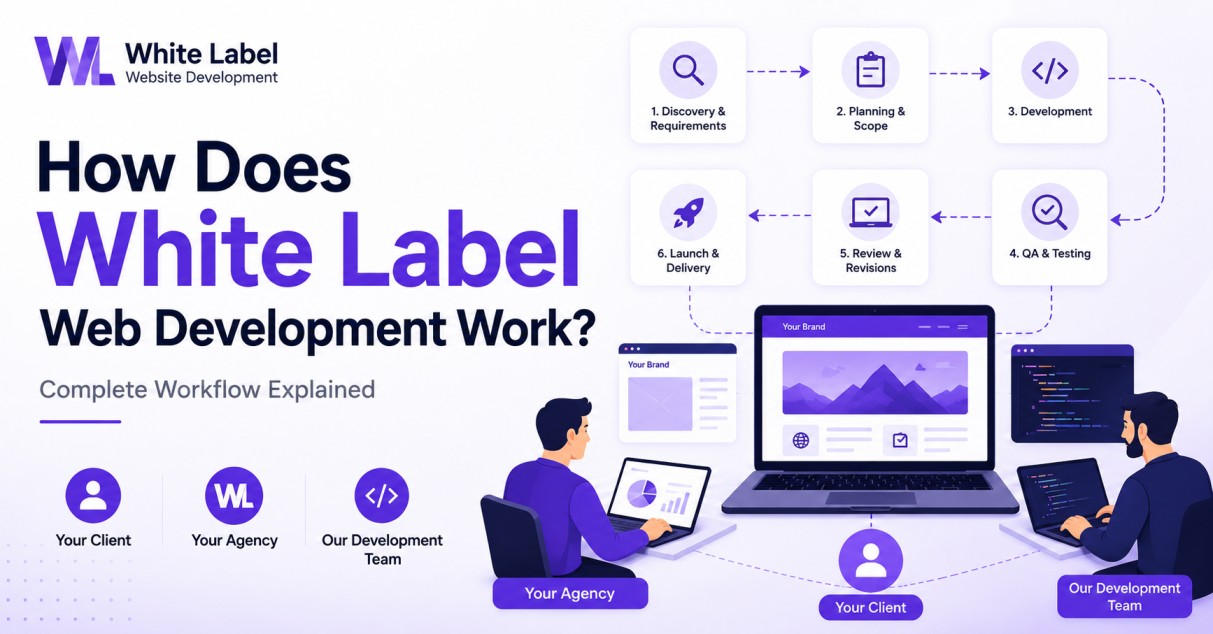
White label web development works by allowing an agency to sell website development under its own brand while a separate development partner handles some or all of the technical work behind the scenes.
The client hires and communicates with the agency. The agency manages the relationship, defines the project, sets its client-facing price, and oversees delivery. The white label web development partner provides the agreed development capacity without taking over the agency's client relationship.
At its simplest, the model looks like this:
Client → Your Agency → White Label Development Partner → Your Agency → Client
For example, an SEO agency may win a WordPress website project but have no available WordPress developers. Instead of rejecting the project, hiring a permanent employee, or referring the client elsewhere, the agency can work with a white label development team. The partner builds the website according to the agreed scope, the agency reviews the work, and the finished project is delivered through the agency.
That sounds straightforward, but a reliable white label workflow involves much more than forwarding a client's email to a developer. Scope definition, confidentiality, project ownership, communication, quality assurance, revisions, deployment, and post-launch support all need clearly defined processes.
This guide explains how white label web development works from the first client inquiry through development, QA, launch, maintenance, and long-term agency scaling.
Table of Contents
- What Is the White Label Web Development Workflow?
- Who Is Involved in a White Label Development Project?
- Step 1: The Agency Receives a Client Opportunity
- Step 2: Discovery and Requirements Gathering
- Step 3: Internal Qualification
- Step 4: The White Label Partner Reviews the Project
- Step 5: Scope, Timeline, and Cost Are Defined
- Step 6: The Agency Creates the Client Proposal
- Step 7: NDA, Confidentiality, and Access Rules Are Established
- Step 8: Project Kickoff and Handoff
- Step 9: Design and Development Begin
- Step 10: Internal Communication and Project Management
- Step 11: Quality Assurance and Testing
- Step 12: Agency Review
- Step 13: Client Review and Feedback
- Step 14: Revisions and Change Requests
- Step 15: Pre-Launch Checks
- Step 16: Website Launch
- Step 17: Handover and Documentation
- Step 18: Maintenance and Ongoing Support
- How Client Communication Works
- How Agencies Price White Label Projects
- How Revisions and Scope Creep Should Be Managed
- White Label Workflow vs Traditional Outsourcing
- How to Build a Scalable White Label Workflow
- Common White Label Workflow Mistakes
- Frequently Asked Questions
What Is the White Label Web Development Workflow?
A white label web development workflow is the process an agency and its development partner use to move a client website from initial inquiry to completed project without disrupting the agency's ownership of the client relationship.
A typical workflow is:
- Client contacts the agency
- Agency conducts discovery
- Requirements are documented
- White label partner reviews technical requirements
- Scope, cost, and timeline are established
- Agency prepares its client proposal
- Client approves the project
- Agency hands the project to its development partner
- Development takes place
- Development team performs QA
- Agency reviews the work
- Client reviews the website
- Revisions are completed
- Pre-launch checks are performed
- Website launches
- Access and documentation are handed over
- Maintenance and ongoing support begin
The client does not necessarily need to interact directly with the development partner at any point.
That is one of the defining characteristics of a structured white label relationship.
Who Is Involved in a White Label Development Project?
Most white label projects involve three primary parties.
1. The End Client
The end client is the business purchasing the website or development service.
For example, the client might be:
- a dental practice
- law firm
- ecommerce company
- SaaS business
- local contractor
- real estate company
- professional services firm
The client typically contracts with the agency rather than the white label development partner.
2. The Agency
The agency owns or manages the client relationship.
Depending on the arrangement, it may be responsible for:
- lead generation
- sales
- discovery
- strategy
- proposals
- contracts
- client communication
- project management
- content
- design
- approvals
- invoicing
- final delivery
The agency may handle all of these responsibilities or only some of them.
3. The White Label Development Partner
The development partner performs the technical work agreed upon with the agency.
That may include:
- website development
- WordPress development
- WooCommerce development
- frontend development
- responsive implementation
- landing page development
- custom functionality
- integrations
- technical fixes
- performance work
- testing
- deployment
- maintenance
The exact division of responsibilities should be established before the project begins.
Step 1: The Agency Receives a Client Opportunity
The white label workflow normally begins before the development partner becomes involved.
Suppose you operate an SEO agency.
An existing client says:
"We need a new website. Can your agency handle it?"
At this point, you have several options.
You could decline the project.
You could refer the client to another company.
You could hire a developer.
You could find a freelancer.
Or you could deliver the project using a white label development partner.
The advantage of the white label model is that the development requirement does not automatically have to leave your agency.
Instead, website development can become another service within your client relationship.
However, accepting every project immediately is a mistake.
The first step should be understanding what the client actually needs.
Step 2: Discovery and Requirements Gathering
Good development begins with good requirements.
The agency should conduct discovery before asking a development partner for an accurate estimate.
Questions may include:
Business Requirements
- What does the company do?
- Who is the target audience?
- Why is the website being built or redesigned?
- What business outcomes should the website support?
- What problems exist with the current website?
Website Requirements
- How many pages are required?
- Is the website being built from scratch?
- Is an existing website being redesigned?
- Is content already available?
- Is a new design required?
- What CMS should be used?
- Does the client have preferred technologies?
Functional Requirements
Does the website need:
- contact forms?
- appointment booking?
- ecommerce?
- customer accounts?
- payment processing?
- memberships?
- subscriptions?
- calculators?
- search?
- filtering?
- API integrations?
- CRM integration?
- multilingual functionality?
Design Requirements
Determine whether:
- the client already has designs
- the agency will provide designs
- the development partner will handle design
- an existing brand system must be followed
- custom UI/UX work is required
Technical Requirements
Document:
- domain
- hosting
- CMS
- current technology
- existing plugins
- integrations
- analytics
- tracking
- email configuration
- migration requirements
- redirects
- performance requirements
Timeline
Ask:
- Is there a fixed launch date?
- Is the deadline connected to a campaign or event?
- When will content be ready?
- Who needs to approve the project?
A development estimate based on "the client needs a new website" is not a reliable estimate.
The better the discovery, the more accurate the scope.
Step 3: Internal Qualification
Not every project should automatically be sent into production.
Before involving the development partner, the agency should determine whether the opportunity is viable.
Consider:
- Is the client's budget realistic?
- Is the deadline achievable?
- Are the requirements sufficiently clear?
- Does the project match your service offering?
- Does your development partner support the required technology?
- Are there unusual compliance requirements?
- Does the client expect functionality outside your capabilities?
- Is the project commercially worthwhile?
This protects both the agency and its white label partner from spending unnecessary time estimating projects that were never viable.
Step 4: The White Label Partner Reviews the Project
Once the opportunity has been qualified, the agency sends the project brief to its white label development partner.
A useful brief might include:
- project summary
- sitemap
- page count
- design status
- required CMS
- functional requirements
- integrations
- reference websites
- content status
- existing website URL
- hosting information
- target deadline
- special requirements
The partner then evaluates the project from a technical perspective.
This review is important because an account manager may see a simple feature where a developer sees significant complexity.
For example:
"The client wants customers to create accounts and see their previous orders."
That one sentence may involve authentication, database architecture, ecommerce configuration, privacy considerations, UI states, email notifications, password recovery, and testing.
Technical review should happen before the agency promises a final price or deadline whenever the project contains uncertain requirements.
Step 5: Scope, Timeline, and Cost Are Defined
The next stage is converting requirements into a defined scope of work.
A good scope should clarify what is included.
For example:
Website
- WordPress development
- up to 10 standard pages
- responsive implementation
- contact form
- blog
- basic CMS configuration
Design
- development from supplied Figma designs
Integrations
- Google Analytics
- Google Tag Manager
- CRM form integration
Testing
- desktop testing
- tablet testing
- mobile testing
- major browser testing
Revisions
- two consolidated revision rounds
Deployment
- staging environment
- production deployment
It should also identify exclusions.
For example:
- copywriting not included
- logo design not included
- paid plugin licenses not included
- advanced custom integrations not included
- ongoing maintenance not included unless purchased separately
The more precise the scope, the easier it becomes to protect:
- timeline
- margin
- quality
- expectations
Step 6: The Agency Creates the Client Proposal
The white label development partner normally quotes the agency.
The agency then creates its own proposal for the client.
These are two separate commercial relationships.
For example:
| Item | Amount |
|---|---|
| White label development cost | $2,500 |
| Agency's internal project costs | $800 |
| Total delivery cost | $3,300 |
| Client price | $5,500 |
| Gross project contribution before other overhead | $2,200 |
These numbers are only illustrative.
The important principle is that agencies should not calculate pricing using development cost alone.
The agency may also be responsible for:
- acquiring the customer
- discovery
- sales
- project management
- client meetings
- design
- content coordination
- QA
- revision management
- support
- payment processing
- business overhead
Your client price should reflect the complete service being delivered.
Step 7: NDA, Confidentiality, and Access Rules Are Established
White label development often requires the partner to work with information belonging to both the agency and the end client.
That can include:
- client identities
- website credentials
- hosting accounts
- staging environments
- business documents
- analytics
- customer information
- proprietary designs
- internal strategy
- source code
Confidentiality therefore needs to be addressed early.
Depending on the engagement, this may include an NDA, subcontracting provisions, data-processing terms, intellectual-property clauses, and rules regarding direct client contact.
Our NDA and confidentiality approach provides additional information about how confidentiality can fit into a white label relationship.
The operational side matters just as much as the agreement.
Ask:
- Who receives credentials?
- Where are passwords stored?
- Can developers contact the client?
- Can completed work appear in the partner's portfolio?
- Who owns hosting accounts?
- Who controls repositories?
- When is access removed?
Confidentiality should be part of the workflow rather than an afterthought.
Step 8: Project Kickoff and Handoff
Once the project is approved, the agency formally hands the project into production.
A proper handoff should contain everything the development team needs.
That may include:
- approved scope
- sitemap
- designs
- brand guidelines
- content
- images
- logos
- fonts
- credentials
- technical requirements
- integrations
- analytics IDs
- SEO requirements
- deadline
- project contacts
- approval process
One of the most common causes of development delays is starting before required assets are available.
For example, development begins Monday, but:
- content arrives Friday
- images arrive next week
- the client changes the sitemap
- the agency still has not approved mobile designs
The development deadline then becomes meaningless.
A strong kickoff identifies dependencies before production starts.
You can review our development process for an example of how a structured delivery process can be organized.
Step 9: Design and Development Begin
The exact production workflow depends on the service.
Design-to-Development Projects
If the agency supplies approved Figma or other design files, the partner focuses primarily on implementation.
The workflow may be:
Approved design → Development → Responsive adaptation → Functional implementation → QA
Design-and-Development Projects
If the white label partner also handles design:
Requirements → Wireframe → Design → Agency approval → Development → QA
WordPress Development
A white label WordPress development project may include:
- WordPress setup
- theme development or customization
- page builder implementation
- reusable components
- custom post types
- forms
- plugin configuration
- responsive layouts
- performance work
WooCommerce Development
A white label WooCommerce development workflow may also involve:
- product structure
- cart
- checkout
- payment gateways
- shipping
- tax configuration
- customer accounts
- transactional emails
- ecommerce testing
Landing Pages
For campaign-focused projects, white label landing page development may follow a shorter production cycle.
The development workflow should match the project rather than forcing every website through an identical process.
Step 10: Internal Communication and Project Management
Communication becomes more complicated in white label development because information often travels through multiple layers.
A typical path is:
Client → Agency Account Manager → Agency Project Manager → White Label Partner → Developer
Then the response travels back:
Developer → White Label Partner → Agency → Client
Without structure, information can become distorted.
For example, the client says:
"Can we make the product cards slightly smaller on desktop but keep the mobile layout unchanged?"
By the time that request reaches development, it may become:
"Make product cards smaller."
The developer changes everything, including mobile.
This creates unnecessary revisions.
A better workflow uses documented tasks.
Each request should ideally contain:
- page or screen
- issue
- requested change
- device
- reference screenshot if applicable
- priority
- acceptance criteria
Instead of:
"Homepage doesn't look right."
Use:
"Homepage > Services section > Desktop: reduce vertical spacing between the heading and cards to match the approved Figma design. Mobile layout should remain unchanged."
Clear instructions reduce ambiguity.
Step 11: Quality Assurance and Testing
Development being "finished" does not mean a website is ready for the client.
QA should happen before client review.
Depending on the project, testing may include:
Visual QA
Check:
- typography
- spacing
- alignment
- images
- icons
- buttons
- colors
- layout consistency
Responsive QA
Check common:
- desktop widths
- laptop widths
- tablets
- mobile devices
Responsive testing should examine behavior, not just whether the website technically fits on a screen.
Functional QA
Test:
- navigation
- buttons
- forms
- validation
- search
- filters
- accounts
- checkout
- payment flows
- integrations
Content QA
Check:
- missing content
- placeholder text
- spelling
- incorrect links
- broken images
- duplicate sections
Browser Testing
Requirements vary, but important target browsers should be agreed upon.
SEO QA
An SEO-aware development process should consider:
- crawlability
- title/meta implementation capability
- heading structure
- canonical configuration
- redirects
- indexation settings
- XML sitemap availability
- internal links
- structured data where appropriate
- image alt attributes
- URL structure
Agencies that sell SEO should be especially careful here.
A beautiful website that creates serious technical SEO problems can undermine the agency's own marketing work.
Our SEO-friendly web development service focuses on integrating development with these requirements.
Performance Checks
Review relevant issues such as:
- oversized images
- unnecessary scripts
- caching
- asset loading
- server configuration
- layout instability
Google documents Core Web Vitals around loading performance, responsiveness, and visual stability, making performance an important consideration for modern websites.
Step 12: Agency Review
After development QA, the agency should review the website before sending it to the client.
This creates another quality-control layer.
The agency should ask:
- Does the website match what we sold?
- Does it match the approved design?
- Is the client's content correct?
- Are important business requirements satisfied?
- Are marketing requirements implemented?
- Are there obvious usability issues?
- Is anything likely to create unnecessary client concern?
This step matters because the agency often understands the client's expectations better than the development team.
The development partner understands the build.
The agency understands the relationship.
Both perspectives are valuable.
Step 13: Client Review and Feedback
After internal approval, the agency presents the website to the client.
Client review should be structured.
Instead of accepting feedback through:
- Slack
- phone calls
- text messages
- screenshots
- separate documents
all at the same time, establish one primary feedback method.
Ask the client to consolidate feedback wherever possible.
This reduces contradictions such as:
Email: Make the button blue.
WhatsApp: Keep the button purple.
Meeting: Maybe try green.
Structured feedback also makes it easier to determine whether a request is:
- a bug
- an agreed revision
- a content update
- a new requirement
Those are not the same thing.
Step 14: Revisions and Change Requests
Revision management is one of the most important parts of a profitable white label workflow.
Consider this situation.
The original scope includes:
Contact form with name, email, phone, and message.
During review, the client says:
"Can users create accounts, upload documents, and track their requests?"
That is not a normal revision to the contact form.
It is new functionality.
A professional workflow distinguishes between:
Bug
Something does not work as agreed.
Revision
An allowed adjustment to work already included in scope.
Content Change
Text, images, or other content needs updating.
Change Request
The client requests functionality or deliverables outside the original scope.
Change requests should trigger a defined process:
- Document request
- Evaluate technical impact
- Estimate additional cost
- Estimate timeline impact
- Get approval
- Schedule development
Without change control, a profitable project can quickly become unprofitable.
Step 15: Pre-Launch Checks
Before launch, conduct a final review.
A pre-launch checklist may cover:
Domain and Hosting
- production hosting ready
- domain access available
- DNS plan confirmed
- SSL ready
Website
- approved pages complete
- navigation correct
- forms working
- links checked
- responsive layouts reviewed
- placeholder content removed
SEO
- production indexation settings reviewed
- titles/meta implementation checked where applicable
- redirects prepared
- canonical configuration checked
- sitemap available
- robots directives reviewed
One particularly important issue is staging-site configuration.
Development websites are often intentionally blocked from search engines.
Those restrictions should not accidentally remain on the production site after launch.
Analytics
Where required:
- analytics installed
- tag manager installed
- conversion tracking configured
- consent implementation reviewed
Backup
Create an appropriate backup or restore point before major migration or deployment work.
Step 16: Website Launch
Launch can take several forms.
Same-Server Launch
The staging website is moved or promoted to production.
Hosting Migration
The site moves from one server to another.
Domain Change
The project may involve moving from a temporary or previous domain.
Existing Website Replacement
The new website replaces the current production site.
The launch process should be planned rather than improvised.
For important websites, agencies should also consider:
- expected downtime
- DNS propagation
- rollback procedure
- redirects
- email dependencies
- analytics
- forms
- payment systems
After deployment, run another production check.
A website that worked perfectly on staging can behave differently in production because of:
- caching
- server configuration
- domain settings
- SSL
- environment variables
- API restrictions
- third-party integrations
Step 17: Handover and Documentation
Once the website is live and approved, the project enters handover.
Depending on scope, handover may include:
- CMS credentials
- hosting credentials
- repository access
- plugin/license information
- documentation
- design files
- training
- backup information
- maintenance instructions
The agency should know exactly what it owns and what the client owns.
Third-party software may have separate licensing terms.
For example, a commercial WordPress plugin does not automatically become unrestricted intellectual property simply because it was installed on a client website.
Clear documentation prevents problems later.
Step 18: Maintenance and Ongoing Support
Launch should not automatically mean the relationship ends.
Websites require ongoing attention.
Depending on the technology, this may include:
- software updates
- plugin updates
- theme updates
- backups
- uptime monitoring
- security monitoring
- bug fixes
- content updates
- performance improvements
- new landing pages
- feature development
Agencies can either manage this internally or continue using a white label website maintenance service.
This also creates an opportunity to move from one-time project revenue toward recurring revenue.
For example, an agency might sell:
Website Build → Maintenance → SEO → Landing Pages → Conversion Optimization → Ongoing Development
The initial website can therefore become the foundation of a much longer client relationship.
How Client Communication Works in White Label Development
There are several possible communication models.
Model 1: Agency-Only Client Communication
This is the strictest white label model.
Client ↔ Agency ↔ Development Partner
The development partner never communicates directly with the client.
Advantages
- maximum brand control
- clear client ownership
- partner remains invisible
Disadvantages
- agency becomes communication bottleneck
- technical questions can take longer
- requirements may lose detail
Model 2: Partner Joins as Part of the Agency Team
The developer or technical project manager may join selected calls while presented according to the agreed agency structure.
This can reduce communication friction on technically complex projects.
However, confidentiality, representation, and client-contact rules must be clearly agreed.
Model 3: Hybrid Communication
The agency handles normal communication while technical specialists participate only when necessary.
This can work well for projects involving:
- complex integrations
- custom functionality
- migrations
- infrastructure
- technical troubleshooting
There is no universal best model.
The right choice depends on how your agency operates.
What matters is that everyone understands the rules before the first client meeting.
How Agencies Price White Label Projects
The white label partner's price and the agency's client price should not be confused.
Suppose the development partner charges:
$3,000
The agency should not automatically say:
"We'll add 20%, so the client price is $3,600."
That ignores the agency's own costs.
A more complete pricing model is:
Development cost + agency delivery cost + risk allowance + desired profit = client price
Agency delivery costs may include:
- sales
- discovery
- design
- project management
- client meetings
- content coordination
- QA
- revision management
- payment fees
- post-launch support
If the partner costs $3,000 but the agency spends another $1,500 managing the engagement, the true project cost is already $4,500 before broader overhead.
For additional context around project costs, review our white label development pricing.
How Revisions and Scope Creep Should Be Managed
Scope creep is especially dangerous in white label projects because the agency can be caught between two different commercial relationships.
The client says:
"It's just one small change."
The development partner says:
"That's outside the agreed scope."
Both may be correct from their own perspective.
The solution is a documented change-management process.
Define Revisions Before Development
Your proposal might include:
Two consolidated revision rounds covering reasonable adjustments to the approved design and included functionality.
Then define exclusions.
For example:
New pages, new functionality, new integrations, structural redesigns, or requirements introduced after scope approval may require additional estimates.
Consolidate Feedback
Ten client emails should not automatically become ten separate revision cycles.
Collect feedback.
Organize it.
Remove duplicates.
Resolve contradictions.
Then send one actionable list to development.
This improves efficiency for everyone.
White Label Workflow vs Traditional Outsourcing
White label development and outsourcing overlap, but the workflows are not always identical.
| Area | White Label Development | Traditional Outsourcing |
|---|---|---|
| External production | Yes | Yes |
| Agency branding | Usually central | Not necessarily |
| Client relationship | Usually retained by agency | Varies |
| Direct vendor visibility | Often limited | Often acceptable |
| Resale model | Common | Not required |
| NDA/confidentiality | Often important | Depends on engagement |
| Client solicitation rules | Often explicitly defined | May not be relevant |
| Agency margin | Usually built into model | Varies |
White labeling is therefore best understood as a specialized outsourcing model designed around agency delivery and brand ownership.
How to Build a Scalable White Label Workflow
Completing one outsourced website is relatively easy.
Delivering dozens consistently is much harder.
Scalability comes from standardization.
Standardize Lead Qualification
Create rules for:
- minimum budget
- supported platforms
- ideal project size
- required information
- unsupported functionality
Standardize Discovery
Use a project intake form.
Collect the same core information for every project.
Standardize Scoping
Create templates for common services such as:
- WordPress website
- WooCommerce store
- landing page
- website redesign
- maintenance plan
Standardize Handoffs
Every project should enter development with a predictable set of assets.
Standardize QA
Use checklists rather than memory.
Standardize Feedback
Use one feedback system.
Standardize Launch
Create a repeatable launch checklist.
Standardize Maintenance
Define what happens after the warranty or post-launch period.
The goal is to reduce the number of decisions your team has to reinvent for every client.
A Practical White Label Workflow for Agencies
A mature agency workflow might look like this:
| Stage | Agency Responsibility | White Label Partner Responsibility |
|---|---|---|
| Lead generation | Primary | None |
| Sales | Primary | Usually none |
| Discovery | Primary | Technical input when needed |
| Technical scoping | Shared | Primary technical review |
| Client proposal | Primary | Provides partner estimate |
| Client contract | Primary | None unless agreed |
| Design | Agency, partner, or shared | Depends on scope |
| Development | Oversight | Primary |
| Development QA | Review | Primary |
| Client presentation | Primary | Usually none |
| Feedback collection | Primary | Receives consolidated tasks |
| Revisions | Oversight | Primary |
| Launch | Shared | Technical deployment |
| Client billing | Primary | None |
| Maintenance | Agency or shared | Depends on arrangement |
This division is not mandatory.
The important thing is to establish responsibilities instead of assuming them.
Common White Label Workflow Mistakes
1. Quoting Before Technical Review
A salesperson promises a $3,000 project.
Development later discovers $6,000 worth of work.
The agency now has three bad choices:
- absorb the loss
- increase the client's price
- reduce the scope
Technical uncertainty should be resolved before final commitments whenever possible.
2. Starting Without Complete Requirements
Developers cannot reliably build from assumptions.
Missing requirements lead to:
- rework
- delays
- disputes
- extra costs
3. No Single Source of Truth
Project information spread across email, chat, documents, calls, and voice messages becomes difficult to manage.
Maintain one authoritative task or project system.
4. Forwarding Raw Client Feedback
The agency should interpret and organize feedback before sending it to development.
Otherwise the partner becomes responsible for deciphering the client relationship without having full context.
5. Skipping Internal QA
Do not send unfinished development work directly to the client simply because the developer says it is ready.
6. Undefined Revision Limits
"Revisions included" is too vague.
Define the revision process.
7. Ignoring Mobile Until the End
Responsive behavior should be considered throughout development.
8. No Launch Checklist
Small launch mistakes can have large consequences.
Examples include:
- broken forms
- missing redirects
- blocked indexing
- missing analytics
- incorrect DNS
- expired SSL
- broken integrations
9. No Post-Launch Responsibility
Clients will report issues after launch.
Define:
- warranty period
- bug-fix policy
- maintenance responsibilities
- support process
before launch.
10. Choosing a Partner Based Only on Price
Development cost matters.
But the cheapest quote can become expensive if it creates:
- excessive revisions
- project management overhead
- missed deadlines
- poor client retention
- rebuilding work
Evaluate the total delivery model.
How Long Does the White Label Development Process Take?
There is no single timeline for every project.
A straightforward marketing website may require much less time than:
- a large ecommerce store
- a membership platform
- a multilingual website
- a custom integration
- a highly interactive website
Timeline depends on:
- project size
- design status
- content readiness
- technical complexity
- integrations
- client approval speed
- revision volume
- team capacity
An important distinction is development time versus project duration.
A website may require only a certain number of development days but remain open for much longer because the project is waiting for:
- content
- client feedback
- credentials
- approvals
- third-party access
Agencies should account for both.
What Information Should You Give a White Label Developer?
At minimum, provide enough information to eliminate avoidable assumptions.
A useful handoff can include:
- project objective
- approved scope
- sitemap
- page list
- design files
- content
- brand assets
- functionality requirements
- CMS requirements
- integrations
- credentials
- reference sites
- responsive requirements
- SEO requirements
- tracking requirements
- deadline
- feedback process
- approval authority
For complex projects, technical acceptance criteria may also be useful.
Instead of:
"Add CRM integration."
Specify:
"When the contact form is submitted successfully, create a contact in the client's CRM with name, email, phone, service selection, and source fields."
Specific requirements are easier to build and test.
How Does White Label WordPress Development Work?
The overall workflow remains similar, but WordPress introduces platform-specific responsibilities.
A typical project may follow:
Requirements → Design → WordPress setup → Theme/page implementation → Plugin configuration → Custom functionality → Responsive testing → QA → Client review → Launch
The agency and development partner should also agree on:
- theme choice
- page builder
- premium plugin licensing
- custom plugins
- hosting
- backups
- updates
- administrator access
- maintenance responsibility
Agencies can use white label WordPress development when they want to sell WordPress projects without handling all development internally.
How Does White Label Website Maintenance Work?
Maintenance usually operates differently from project-based development because the relationship is recurring.
The agency sells a maintenance or care plan to the client.
The white label partner then performs agreed maintenance tasks behind the scenes.
These may include:
- updates
- backups
- uptime monitoring
- security checks
- bug fixes
- small content changes
- performance checks
The workflow might be:
Client pays agency monthly → Agency manages account → Partner performs maintenance → Issues are documented → Agency reports to client
This can create predictable recurring revenue for the agency while giving clients ongoing technical support.
How Does White Label Development Help an Agency Scale?
The model changes how development capacity is acquired.
Without external support, an agency facing increased demand generally has to:
- hire
- delay projects
- use individual freelancers
- reject work
A white label partner adds another option.
The agency can maintain a smaller internal team while purchasing additional capacity when required.
This can be particularly valuable when demand is uneven.
However, scalability depends on the partner being able to scale too.
Before relying heavily on one provider, understand:
- concurrent project capacity
- available technologies
- project management resources
- QA resources
- turnaround expectations
- escalation process
Scaling a broken workflow only creates problems faster.
How Do You Know If Your White Label Workflow Is Working?
Track operational metrics rather than relying entirely on impressions.
Useful metrics can include:
Estimate Accuracy
How often does actual development effort significantly exceed the estimate?
On-Time Delivery Rate
How frequently are agreed milestones achieved?
Revision Rate
How much rework is required after internal QA?
QA Defect Rate
How many issues reach the client?
Average Project Margin
Does the service remain profitable after internal management costs?
Client Satisfaction
Are clients satisfied with the delivered work?
Support Load
How much post-launch support does each project generate?
Partner Response Time
Are technical questions answered quickly enough to keep projects moving?
Change Request Frequency
Are scopes consistently missing important requirements?
Metrics can reveal where the workflow needs improvement.
For example, frequent change requests may indicate poor discovery rather than poor development.
Should the White Label Partner Ever Contact Your Client?
There is no universal rule.
In some arrangements, the answer is no.
In others, technical specialists may participate in client meetings under predefined conditions.
The important issue is authorization.
The partner should not independently:
- solicit the client
- sell additional services
- discuss unrelated commercial terms
- change project scope
- make commitments
- share confidential information
unless the agency has authorized that interaction.
Client-contact rules should be established contractually and operationally.
Who Is Responsible If Something Goes Wrong?
Responsibility depends on the underlying agreements.
From the end client's perspective, the agency may still be responsible for delivering what it promised.
Separately, the agency's agreement with its development partner determines the partner's obligations.
This is why agencies need two well-aligned scopes:
Agency ↔ Client
and
Agency ↔ Development Partner
If the client contract promises functionality that the partner scope does not include, the agency has created a delivery gap.
The two scopes should align before production begins.
What Makes a Good White Label Development Workflow?
A good workflow is not necessarily complicated.
It is predictable.
Everyone should know:
- what happens next
- who owns each task
- what information is required
- who can approve work
- how feedback is submitted
- what counts as additional scope
- when invoices are due
- how launch works
- what happens after launch
The strongest workflows reduce ambiguity.
That benefits:
the client, because delivery becomes more predictable;
the agency, because margin and client relationships are protected;
and the development partner, because requirements and responsibilities are clearer.
White Label Website Builder FAQs
Need production capacity, not another builder?
We build SEO-ready websites under your brand — NDA friendly, dedicated PM, delivered on schedule.
Get a free white label quote