
12 Best White Label Website Builders for Agencies (2026)
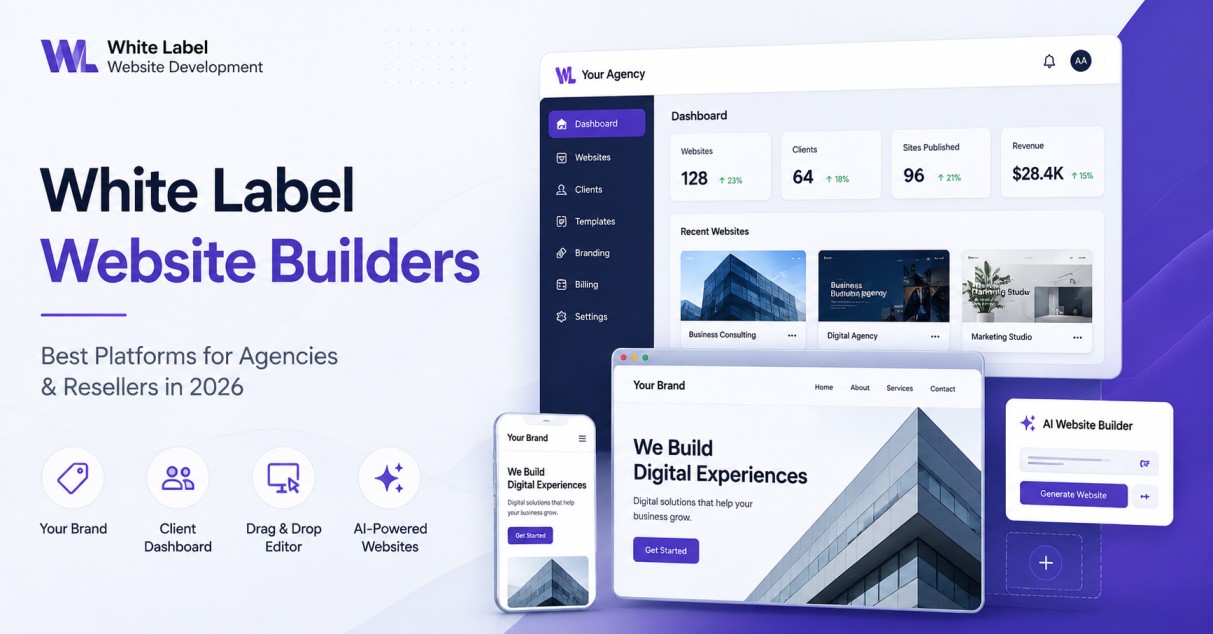
A white label website builder is website-building software made by one company but sold and presented under another company's brand. Your logo, your domain, your dashboard, your pricing — someone else's engineering.
For agencies, freelancers, hosting providers, SaaS companies and resellers, that model solves a specific scaling problem. Winning more clients is good; but every new website can also mean more design work, more development hours, more revisions, more maintenance, and more people needed to deliver the work. A builder lets you standardize the repeatable work instead of rebuilding it from scratch each time. Depending on the platform, you may be able to use your own logo, domain, dashboard, templates, client login, pricing structure, email notifications and even billing system — and some platforms now go considerably further with AI website generation, APIs, reseller infrastructure, ecommerce, client management and SaaS capabilities.
The catch is that white labeling varies significantly between providers. A platform that lets you drop a logo into a dashboard is not equivalent to a platform that lets you operate a fully branded website builder business. Choosing wrong is expensive, because platform limits are usually discovered after you have onboarded dozens of clients — exactly when migrating is hardest.
This guide compares the best white label website builders for agencies and resellers in 2026 — Duda, Brizy, Simvoly, Site.pro, Wix Studio and WordPress-based stacks — and covers how the reseller business model works, what white labeling actually includes, pricing and cost-per-client maths, AI and API capabilities, free and open-source options, and how to evaluate a platform before committing your client base to it.
Who This Guide Is For
- Web design agencies standardizing production without hiring more developers
- SEO agencies and digital marketing agencies adding websites to an existing retainer
- Freelancers who want recurring revenue instead of one-off builds
- Hosting companies bundling a builder into hosting accounts
- SaaS founders embedding website creation into an existing product
- Website resellers and entrepreneurs launching a website subscription service
If what you actually need is production capacity rather than another piece of software, jump to white label builder vs white label development — a different model, and often the better one.
Table of Contents
- What Is a White Label Website Builder?
- How White Label Website Builders Work
- Best White Label Website Builders by Use Case
- The 12 Best White Label Website Builders for 2026
- Best White Label AI Website Builder
- Best Builder for Agencies
- Best Builder for Resellers
- WordPress White Label Builders
- Free White Label Website Builders
- Pricing
- Features to Look For
- Builder vs Traditional Website Builder
- Builder vs Custom Development
- Revenue Models
- How to Start a Reseller Business
- White Label Website Builder APIs
- SaaS Use Cases
- Open-Source and Self-Hosted Options
- How to Evaluate a Platform
- Selection Checklist
- How to Choose the Right Platform
- Final Recommendations
- FAQs
- Final Thoughts
Quick Answer
There is no single best white label website builder — the right one depends on your business model. Duda suits established web design agencies that build sites for clients and need mature client management with a branded client login. Brizy is the strongest all-rounder when AI website generation, deep reseller branding and WordPress matter together. Simvoly fits agencies that want to sell a branded, subscription-style website and funnel platform of their own. Site.pro targets hosting companies bundling a builder with hosting, with cloud or on-premises deployment. Wix Studio works for teams already committed to the Wix ecosystem. WordPress or custom development is the answer when you need source-code control, unusual functionality or complex ecommerce — or when what you really need is delivery capacity rather than software.
Best White Label Website Builders: Quick Comparison
| Platform | Best For | Full/Partial White Label | AI | API | WordPress | Hosting | Reseller Focus |
|---|---|---|---|---|---|---|---|
| Duda | Established web agencies | Full client-facing white label | Yes | On qualifying plans | No | Included | Strong |
| Brizy | Agencies, hosts and resellers | Full (Cloud reseller program) | Yes | Yes | Yes | Cloud included | Very strong |
| Simvoly | Agencies building a branded SaaS offering | Full | Yes | Platform dependent | No | Included | Very strong |
| Site.pro | Hosting companies | Full | Yes | Integrations available | No | Cloud or on-premises | Very strong |
| Wix Studio | Agencies wanting a managed ecosystem | Partial (agency branding) | Yes | Developer ecosystem | No | Included | Moderate |
| WordPress-based stack | Agencies wanting maximum control | Depends on implementation | Plugin dependent | Yes | Native | Self-arranged | Depends on setup |
Read the white label column carefully — that is where most agencies get caught. Full white label generally means the client never encounters the vendor's name across dashboard, login, preview domain and notification emails. Partial white label usually means agency branding sits alongside platform branding. The hosting and API columns matter most to hosting providers and SaaS teams that need automated provisioning rather than manual site creation. Pricing and plan features can change, so verify the current pricing on the provider's official website.
Quick recommendation: Duda is particularly strong for traditional agencies that need mature client-management and white-label functionality. Brizy stands out when reseller functionality, WordPress, AI and deeper branding are priorities. Simvoly is worth considering when your goal extends beyond building client sites into selling a branded website/funnel platform. Hosting providers should also investigate Site.pro.
Important: "White label" does not always mean the original platform is completely invisible. Always verify exactly which client-facing elements — dashboard, login URL, preview domain, notification emails, support links, editor chrome — can be rebranded on the specific plan you are buying.
There is no universal winner. The right platform depends on whether you want to build websites for clients, let clients build their own websites, resell software, integrate a builder into an existing SaaS product, or operate a website subscription business.
Best White Label Website Builders by Use Case
- Best overall for agencies — Duda. Mature client management, branded client login and dashboard, and a workflow designed around agencies producing sites for clients.
- Best white label AI website builder — Brizy. Combines AI website generation with reseller-grade branding, so the AI experience itself can be presented as yours.
- Best for resellers — Brizy or Simvoly. Both are built around selling access under your own brand, with branded dashboards and reseller-oriented commercial terms.
- Best for hosting companies — Site.pro. Designed to be bundled into hosting accounts, with cloud and on-premises deployment options.
- Best for WordPress — Brizy with WordPress, or a customized WordPress stack when you need full control of the admin experience.
- Best for SaaS businesses — API-first platforms, where programmatic provisioning matters more than editor polish.
- Best for maximum customization — WordPress or custom development, where source code, architecture and integrations are entirely yours.
Filename: white-label-builder-agency-reseller-saas-comparison.webp — Alt: Agency, reseller, hosting provider and SaaS use cases for a white label website builder
Need the Websites Built for You Instead?
A builder is software, not capacity. If your bottleneck is delivery — design hours, development, revisions, deadlines — a white label development partner solves a different problem than a subscription does. You keep the client, the brand and the margin; production happens behind your name.
What Is a White Label Website Builder?
A white label website builder is website-building software developed and maintained by one company but offered to end users under another company's branding.
Imagine that your agency is called Example Digital.
Instead of telling clients:
"Log into Company X to edit your website."
you could potentially give them something like:
builder.exampledigital.com
The dashboard could display your logo, company name, support links and other branding instead of prominently presenting the underlying software provider.
The technology belongs to the platform provider, while your agency owns the customer relationship and brand experience.
This creates a model similar to many other white-label services.
The provider concentrates on developing and maintaining the underlying product. Your business concentrates on acquiring customers, delivering websites, providing support, bundling services and generating revenue.
That distinction is important because white-label software is not the same thing as white-label website development.
With software, you are primarily licensing or reselling a platform.
With white label website development, an agency can outsource actual design and development work to another development team while continuing to manage the client relationship under its own brand.
The two models can also work together.
An agency might use a website builder for straightforward projects while outsourcing more sophisticated projects that require custom development.
How Does a White Label Website Builder Work?
The exact workflow varies, but a typical setup looks like this:
- Your agency subscribes to a white-label or reseller plan.
- You configure your logo, brand name, domain and other settings.
- You create client accounts or websites.
- Your team or client builds the website using the platform.
- The client interacts with a branded or partially branded environment.
- You charge the client according to your own service model.
- The underlying provider maintains the website-builder technology.
More sophisticated reseller systems can also provide APIs, automated account provisioning, billing integrations, hosting, custom email notifications and domain masking.
For example, Brizy says its Cloud White Label Reseller program can provide custom domains for dashboards and project previews, branded dashboards, customized email notifications and development APIs.
Outbound resource: Brizy Cloud Reseller documentation
This means a white label builder can become much more than an internal productivity tool.
It can become part of the product your agency sells.
Platform Provider → Your Agency Branding → Client Dashboard → Client Website. Filename: white-label-website-builder-workflow.webp — Alt: How a white label website builder works for agencies and clients
Agency tip: Before committing to a platform, build at least one complete test site and let a non-technical person edit it without your help. Unrestricted client editing is one of the most common sources of unplanned support hours.
The 12 Best White Label Website Builders and Solutions for 2026
1. Duda — Best Overall White Label Website Builder for Agencies
Duda is one of the most established options for agencies that want a managed website-building environment with substantial client-facing white-label capabilities.
Its white-label functionality can cover several important parts of the client experience.
According to Duda, agencies can customize elements including the client login screen, website builder, domain, dashboard and website preview experience.
It also provides granular permissions, allowing agencies to control what individual clients and team members can access.
That becomes especially useful once an agency manages dozens or hundreds of websites.
Key Duda White Label Features
Duda offers capabilities such as:
- branded client login
- custom domain
- logo and color customization
- white-label client dashboard
- website preview tools
- client and team permissions
- mobile editing
- drag-and-drop website building
- templates
- hosting and SSL
- SEO functionality
- API access on qualifying plans
Duda's official white-label page currently states that its white-label website-building platform is available on its White Label and Custom plans, with the White Label plan starting at $149 USD per month. Pricing and plan features can change, so agencies should confirm current terms before purchasing.
Outbound resource: Duda White Label Website Builder
Who Should Choose Duda?
Duda is particularly suitable for:
- web design agencies
- digital marketing agencies
- SEO agencies
- agencies managing many SMB websites
- teams that want clients to edit websites
- agencies selling website subscriptions
It is less attractive when you require unrestricted access to the underlying source code or want to build an entirely proprietary website-building architecture.
For agencies that would rather have websites built for them instead of relying primarily on DIY client building, a white label website design service can be an alternative.
2. Brizy — Best White Label AI Website Builder for Resellers
Brizy deserves particular attention because it approaches white labeling from several directions.
There are options for agencies and freelancers, cloud resellers, hosting companies and WordPress users.
Its Cloud reseller program is especially relevant if you're looking for a website builder white label reseller solution rather than simply an internal page builder.
Brizy states that its white-label setup can replace or customize elements such as:
- builder name
- branded domain
- support link
- dashboard logo
- subdomains
- About link
- system notifications
It also provides an AI website-building capability.
White Label AI Website Building
AI is becoming an important differentiator in this market.
Instead of starting every website from a blank canvas or template, an AI builder can generate an initial website that users subsequently refine.
Brizy offers an AI builder that can operate under white-label branding.
Its official materials describe capabilities including domain masking, customized communication, client billing/dashboard functionality and cloud or on-premises deployment options.
Outbound resource: Brizy White Label AI Website Builder
Brizy for WordPress
Brizy also has a particularly interesting proposition for agencies searching for a white label WordPress website builder.
Its WordPress reseller program allows businesses to resell the Brizy WordPress PRO plugin with their own branding.
Brizy says reseller functionality can include agency branding in WordPress admin, customized company information and support/About links.
Development APIs are also available for license automation.
Outbound resource: Brizy WordPress Reseller Program
For agencies whose projects require considerably more customization than a visual builder can provide, our white label WordPress development service provides another delivery model.
Who Should Choose Brizy?
Consider Brizy if you're:
- a digital agency
- freelancer
- WordPress agency
- hosting provider
- reseller
- SaaS business
- company looking for AI website generation
- business planning to integrate website building into another service
3. Simvoly — Best for Building Your Own Branded Website SaaS
Simvoly is particularly interesting when your business model goes beyond simply producing websites.
The platform combines website building with funnels and other marketing/business functionality and positions its white-label offering toward agencies, SaaS businesses, hosting companies and marketers.
Its white-label system allows businesses to apply their own branding and domain and customize the platform experience.
Simvoly also supports custom CSS and JavaScript for additional interface customization.
Why Simvoly Is Different
Imagine an agency currently charging clients $2,000–$5,000 for individual website projects.
A traditional agency model requires continuously acquiring new projects.
A SaaS-style model might instead offer:
- website builder access
- hosting
- templates
- CRM
- funnels
- ecommerce
- appointments
- marketing functionality
for a recurring monthly fee.
That can fundamentally change the agency's revenue structure.
Rather than only selling websites, the agency begins selling access to its own branded platform.
Simvoly explicitly markets its white-label product around this model.
Outbound resource: Simvoly White Label Builder
Best For
Simvoly is worth investigating for:
- agencies creating recurring-revenue products
- funnel-building agencies
- marketers
- SaaS entrepreneurs
- consultants
- businesses that want clients to build websites themselves
4. Site.pro — Best White Label Website Builder for Hosting Companies
Hosting companies have different requirements from ordinary digital agencies.
If you operate a hosting business, you may want customers to see a Website Builder button directly inside their hosting environment.
Site.pro is built heavily around this use case.
The platform offers both cloud and on-premises options and integrates its website builder with hosting and billing environments.
According to Site.pro, white-label customization includes capabilities such as:
- custom domain
- custom logo
- customizable interface
- templates
- ecommerce
- AI website building
- responsive websites
- SEO functionality
- multilingual support
Site.pro also promotes a fixed-fee reseller model.
Outbound resource: Site.pro White Label Website Builder
Cloud vs On-Premises
One notable advantage is deployment flexibility.
Businesses can choose between a cloud deployment and an on-premises installation.
On-premises deployment can matter to hosting providers that want greater infrastructure control than a typical SaaS website builder provides.
Best For
Site.pro is particularly relevant for:
- web hosting companies
- hosting resellers
- domain businesses
- infrastructure providers
- companies needing an on-premises builder
5. Wix Studio — Best for Agencies That Want the Wix Ecosystem
Wix Studio is not identical to the fully white-label reseller platforms discussed above, so the distinction matters.
It does, however, provide custom agency branding functionality for eligible partners.
Wix states that Custom Branding can display an agency's branding in areas such as:
- client email invitations
- client site dashboards
- free-site banners
This makes Wix Studio useful for agencies that value the broader Wix ecosystem and want a more agency-branded client experience.
Outbound resource: Wix Studio Custom Branding documentation
Where Wix Studio Makes Sense
Wix Studio may be attractive if your priority is:
- professional visual development
- managed infrastructure
- client collaboration
- responsive design
- agency workflows
- a large existing platform ecosystem
However, businesses specifically searching for a 100% white label website builder reseller platform should carefully compare Wix Studio's branding model with deeper reseller platforms such as Brizy, Duda, Simvoly and Site.pro.
Do not assume that "custom agency branding" and "complete software white labeling" mean exactly the same thing.
6. WordPress — Best for Maximum Ownership and Customization
WordPress requires a different explanation because WordPress itself is not a turnkey white-label website builder reseller service.
It is open-source content management software.
According to WordPress.org, WordPress is licensed under GPLv2 or later and provides users freedoms to run, study, modify and redistribute the software.
Outbound resource: About WordPress and its open-source licensing
That flexibility allows agencies and software companies to create highly customized WordPress experiences.
A WordPress-based agency stack could combine:
- WordPress
- a page builder
- custom themes
- custom plugins
- agency branding
- managed hosting
- client permissions
- maintenance automation
- custom dashboards
This provides substantially more flexibility than many closed SaaS builders.
But flexibility has a cost.
You become responsible for much more of the technical stack.
When WordPress Makes More Sense
WordPress may be better when:
- clients require custom functionality
- SEO control is important
- you need access to code
- websites require unusual integrations
- content publishing is central
- WooCommerce is required
- long-term platform flexibility matters
If your agency sells WordPress projects but doesn't want to maintain a large internal development team, white label WordPress development allows you to outsource production while retaining the client relationship.
Best White Label AI Website Builder for Agencies
AI website builders have changed what agencies should expect from website-building software.
Traditional builders generally follow this workflow:
Template → Customize → Add Content → Configure → Publish
AI builders can move toward:
Business Information → Generate Website → Review → Customize → Publish
That can dramatically reduce the time required to create the first version of a small business website.
For agencies producing large numbers of relatively standardized websites, this matters.
What Should a White Label AI Website Builder Actually Do?
Do not select a platform simply because its marketing page contains the letters "AI."
Evaluate what the AI actually does.
Useful capabilities may include:
AI Website Generation
The platform should be able to generate meaningful page structures from information about a business.
AI Copy Generation
AI can help generate initial:
- headlines
- service descriptions
- calls to action
- FAQs
- page copy
Human review is still important, especially for factual accuracy, brand voice, legal claims and SEO quality.
AI Layout Generation
More sophisticated systems can use AI to produce page layouts and visual structures rather than merely generating text.
AI Image Capabilities
Some builders integrate image generation, image selection or image editing.
Brand Consistency
For agencies, AI becomes considerably more valuable when generated websites can follow predefined design systems, templates or brand rules.
White-Label AI Experience
This is the critical component for resellers.
If clients interact directly with AI functionality, ask:
Whose brand do they see?
A true white-label AI experience should ideally preserve your branding throughout the workflow.
Brizy is one provider explicitly offering white-label AI website-building functionality.
Best White Label Website Builder for Agencies
There is no single answer because "agency" describes many different businesses.
Small Web Design Agency
Prioritize:
- ease of use
- templates
- client editing
- low learning curve
- predictable pricing
Duda, Brizy and similar managed platforms can make sense.
SEO Agency
An SEO agency should pay particular attention to:
- title and meta controls
- heading structure
- redirects
- canonical controls
- schema capabilities
- image optimization
- crawlability
- page speed
- Core Web Vitals
- sitemap control
- robots directives
A visually impressive builder that restricts technical SEO can become a serious operational problem.
If organic search is central to your service, consider whether a builder is appropriate for every client or whether certain projects need SEO-friendly web development.
High-Volume Agency
If you're producing dozens or hundreds of websites, prioritize:
- reusable sections
- global design systems
- template management
- automated provisioning
- API access
- centralized website management
- permissions
- billing integration
At high volume, saving even 30 minutes per site becomes significant.
Custom Development Agency
A website builder may only solve part of your workload.
Complex websites involving unusual workflows, integrations, portals, advanced ecommerce or custom applications may still require developers.
That is where a hybrid delivery model often works best:
Website builder for standardized projects + custom development for complex projects.
Best White Label Website Builder for Resellers
A reseller has slightly different priorities from an agency.
An agency might build the website for the customer.
A reseller may want customers to purchase access and build the websites themselves.
That means the reseller needs more than an editor.
Look for:
- customer signup
- account creation
- plan management
- white-label dashboard
- branded emails
- billing integration
- pricing control
- domain management
- support workflows
- API
- license management
- usage limits
- analytics
Brizy's reseller documentation, for example, describes an API-driven option as well as third-party billing/client-management integration through Stripe for certain reseller setups.
Outbound resource: Brizy Cloud Reseller onboarding
This illustrates why evaluating a white label website builder reseller program requires more than comparing editors.
You're evaluating business infrastructure.
White Label Drag-and-Drop Website Builders
Drag-and-drop editing remains important even as AI generation becomes more capable.
Why?
Because AI can create the first draft, but somebody still needs to modify it.
A strong white label drag and drop website builder should allow users to visually control:
- sections
- columns
- spacing
- typography
- colors
- images
- buttons
- forms
- navigation
- mobile layouts
- reusable components
The key question isn't simply whether the platform supports drag-and-drop.
Most modern builders do.
Ask instead:
How difficult is it for a non-technical client to accidentally destroy the design?
For agency work, permissions and editing restrictions can sometimes be more important than raw design freedom.
White Label Mobile and Responsive Website Builders
The term mobile website builder white label is less important today than it was when mobile-specific websites were common.
Modern websites should generally be responsive.
A responsive builder creates layouts that adapt across screen sizes instead of maintaining a separate "mobile website."
When comparing platforms, test:
- desktop layouts
- tablets
- common mobile widths
- navigation
- responsive typography
- image behavior
- forms
- tables
- popups
- sticky elements
- Core Web Vitals
Do not rely solely on a platform's marketing screenshots.
Build a real test website and evaluate it across devices before moving your agency's production workflow onto the platform.
White Label Website Builder for WordPress: Builder or Custom Development?
WordPress agencies have several options.
Option 1: Use a White-Label WordPress Builder
A product such as Brizy can provide a visual editor with white-label capabilities.
This works well when you want clients to edit pages without interacting with a highly technical environment.
Option 2: Customize WordPress Yourself
Agencies can create a branded WordPress experience using themes, plugins, custom admin modifications and role restrictions.
This offers more control but creates additional maintenance responsibilities.
Option 3: Outsource WordPress Development
The third approach is to keep project management and client acquisition in-house while outsourcing production.
Our white label WordPress development is designed around this model.
It allows agencies to expand development capacity without presenting another company to their clients.
Need White Label WordPress Development?
Keep the client relationship, the branding and the pricing. We build, migrate and maintain WordPress sites behind your agency's name, with a dedicated point of contact and NDA coverage as standard.
Free White Label Website Builders: Do They Really Exist?
The keyword free white label website builder attracts attention for obvious reasons.
But "free website builder" and "free white-label platform" are very different propositions.
Building and operating website infrastructure costs money.
The provider may need to pay for:
- hosting
- storage
- bandwidth
- SSL
- software development
- security
- backups
- support
- AI usage
- infrastructure
- ongoing maintenance
Therefore, completely free white-label reseller software with substantial commercial capabilities is uncommon.
You may instead encounter:
- free trials
- free builders with provider branding
- limited free tiers
- open-source software
- introductory promotions
- revenue-share arrangements
Be Careful With "Free"
Before adopting a supposedly free white label website builder, investigate:
- Can provider branding actually be removed?
- Can you use your own domain?
- Can you sell websites commercially?
- Is hosting included?
- How many websites can you create?
- Are there bandwidth limits?
- Can clients access the editor?
- Are premium features required for practical use?
- What happens when you exceed the free tier?
- Can you export or migrate your websites?
The cheapest platform is not necessarily the lowest-cost platform once your agency has 50 or 100 client websites tied to it.
White Label Website Builder Pricing: What Does It Really Cost?
Pricing can be deceptive if you compare only the monthly subscription.
Your real cost can include:
Platform subscription + per-site fee + hosting + ecommerce fees + AI usage + premium features + development + support + migration costs
For example, Duda currently advertises its White Label plan starting at $149 per month.
Brizy advertises white-label options under several product/reseller structures, so the appropriate pricing model depends on the implementation.
Always check the provider's current pricing before making a decision.
Calculate Cost Per Client
Filename: white-label-website-builder-cost-per-client.webp — Alt: Formula for calculating white label website builder cost per client
Suppose your total platform expense is $300 per month and you have 30 paying clients.
Your base software cost is:
$300 ÷ 30 = $10 per client/month
If each client pays $79 per month:
$79 - $10 = $69
That $69 is not profit.
You still need to account for:
- customer support
- payment processing
- sales
- marketing
- taxes
- design work
- development
- administration
- revisions
But the calculation demonstrates why website subscriptions can become attractive at scale.
For agencies comparing outsourcing against internal production costs, our white label website development pricing provides another useful benchmark.
Features to Look for in a White Label Website Builder
Choosing a builder should be treated like selecting infrastructure, not selecting a pretty design tool.
Here are the areas we would investigate before committing.
1. Complete Branding Control
Determine exactly where the original provider appears.
Check:
- login page
- dashboard
- editor
- emails
- preview links
- help links
- system messages
- website source
- billing
- client documentation
"White label" can mean different things between vendors.
2. Custom Domain
A branded domain such as:
builder.youragency.com
creates a more coherent client experience than sending customers to a third-party domain.
3. Client Management
Your team should be able to manage multiple clients without maintaining separate, disconnected accounts.
4. User Permissions
Clients usually should not have the same access as developers or administrators.
Granular permissions reduce accidental changes.
5. Drag-and-Drop Editing
The editor should be fast enough for your production team but simple enough for clients if client editing is part of your service.
6. Responsive Design
Test actual websites across devices.
Responsive controls should be practical rather than superficial.
7. SEO Controls
SEO agencies should scrutinize this area.
At minimum, evaluate:
- title tags
- meta descriptions
- URLs
- headings
- alt text
- canonical URLs
- redirects
- schema
- XML sitemaps
- robots directives
- performance
8. Website Performance
A website builder is only useful if the resulting websites perform well.
Pay particular attention to Core Web Vitals.
Google's current Core Web Vitals include:
- LCP — Largest Contentful Paint
- INP — Interaction to Next Paint
- CLS — Cumulative Layout Shift
Outbound resource: Google Search Central: Core Web Vitals
9. Hosting and SSL
Determine whether hosting is:
- included
- mandatory
- optional
- externally configurable
Also investigate SSL, CDN, backups and infrastructure reliability.
10. Ecommerce
If clients sell online, investigate:
- product limits
- payment gateways
- transaction fees
- subscriptions
- taxes
- shipping
- inventory
- coupons
- abandoned carts
For agencies with projects requiring more sophisticated WordPress ecommerce implementations, white label WooCommerce development may be more appropriate than forcing every store into a closed builder.
11. API Access
A white label website builder API becomes increasingly important when you want to integrate website creation into another product.
APIs may enable:
- automated account creation
- website provisioning
- template assignment
- domain connection
- user management
- license management
- publishing
- integration with your SaaS platform
Do not simply ask whether an API exists.
Ask whether the API supports the exact workflow your business needs.
12. AI Capabilities
Test AI rather than trusting feature lists.
Generate websites for several industries and evaluate:
- copy quality
- factual accuracy
- layout quality
- image relevance
- design consistency
- responsiveness
- editing flexibility
13. Migration and Portability
This is one of the most overlooked considerations.
Ask:
What happens if we leave the platform three years from now?
Determine whether websites can be:
- exported
- transferred
- migrated
- self-hosted
Vendor lock-in becomes considerably more serious as your client base grows.
White Label Website Builder vs Traditional Website Builder
| Feature | White Label Builder | Traditional Builder |
|---|---|---|
| Your agency branding | Usually supported | Usually limited |
| Client-facing branding | Agency brand possible | Platform brand common |
| Reselling | Often supported | Often restricted |
| Custom domain for platform | Often available | Less common |
| Client management | Agency focused | Account focused |
| Recurring revenue model | Strong | Possible but less integrated |
| API | Available on some platforms | Varies |
| SaaS potential | High on reseller platforms | Usually limited |
| Setup complexity | Moderate | Low |
| Cost | Usually higher | Often lower |
The key difference is not necessarily website quality.
It is who owns the customer experience.
White Label Website Builder vs Custom Website Development
This comparison is more important.
Website builders are efficient, but they are not appropriate for every project.
| Requirement | Website Builder | Custom Development |
|---|---|---|
| Simple marketing site | Excellent | Often unnecessary |
| Fast deployment | Excellent | Slower |
| Low initial cost | Strong | Usually higher |
| Client DIY editing | Excellent | Depends on CMS |
| Unique functionality | Limited | Excellent |
| Complex integrations | Platform dependent | Excellent |
| Source-code control | Limited | Excellent |
| Custom architecture | Limited | Excellent |
| High-volume standardized sites | Excellent | Expensive |
| Complex web application | Usually poor fit | Excellent |
This is why agencies should avoid treating the decision as:
Builder OR development.
A better model is often:
Builder AND development.
Use standardized technology where standardization creates efficiency.
Use custom development where differentiation or functionality requires it.
If you're evaluating a project and aren't sure which approach is appropriate, a white label website audit can help identify technical and performance requirements before committing to a delivery method.
Not Sure Whether a Builder Is Enough?
Platform limitations are cheapest to discover before onboarding, not after fifty client sites are live. An audit of the technical, performance and SEO requirements will tell you whether a builder covers the project or whether it needs development.
White Label Website Builder vs White Label Website Development
These terms sound similar but describe different business models.
White Label Website Builder
You license software that helps you or your customers build websites.
You receive: technology.
White Label Website Development
Another team performs development work behind the scenes while your agency owns the client relationship.
You receive: production capacity and expertise.
The development partner may handle:
- frontend development
- WordPress
- WooCommerce
- landing pages
- responsive implementation
- technical fixes
- maintenance
while remaining invisible to your end client.
For agencies that need development capacity rather than another software subscription, learn more about becoming an agency partner.
Confidentiality is particularly important in this relationship, which is why agencies should also understand the provider's NDA and confidentiality policy.
How Agencies Can Make Money With a White Label Website Builder
A white label builder creates several possible revenue streams.
1. Website Setup Fees
Charge an upfront fee for:
- design
- setup
- content
- configuration
- domain connection
- launch
For example:
Setup: $1,500
2. Monthly Website Subscription
Instead of transferring the website and ending the relationship, charge recurring access.
For example:
$99/month
The package might include:
- website
- hosting
- SSL
- support
- minor updates
3. Website Maintenance
Clients eventually need updates.
Maintenance can become a separate recurring service.
Our white label website maintenance service is one way agencies can outsource this operational workload while keeping their own client relationship.
4. SEO
The website launch should not necessarily end the engagement.
Agencies can upsell:
- technical SEO
- local SEO
- content
- landing pages
- link acquisition
- conversion optimization
5. Ecommerce
Online stores can generate higher project values and ongoing support opportunities.
6. Landing Pages
Advertising clients constantly need campaign pages.
Rather than rebuilding them manually each time, agencies can combine reusable systems with white label landing page design.
7. Hosting
Depending on the platform and business model, hosting can be included in your recurring fee.
8. Premium Support
Offer different tiers:
Basic: software access
Growth: software + support
Managed: software + updates + marketing
Premium: fully managed website + SEO + development
This turns one website product into multiple customer segments.
Example White Label Website Builder Business Model
Consider a hypothetical agency called Northstar Digital.
It launches three packages:
| Plan | Monthly Price | Service |
|---|---|---|
| Starter | $49 | Website builder + hosting |
| Business | $99 | Builder + hosting + support |
| Managed | $249 | Website + updates + priority support |
Suppose it reaches:
- 100 Starter customers
- 50 Business customers
- 20 Managed customers
Monthly recurring revenue would be:
100 × $49 = $4,900
50 × $99 = $4,950
20 × $249 = $4,980
Total:
$14,830 MRR
Annualized recurring revenue:
$177,960
Again, this is revenue—not profit.
Software, support, marketing, payment processing, staffing, churn and taxes must still be deducted.
But it illustrates why agencies increasingly investigate website-builder reseller models.
How to Start a White Label Website Builder Reseller Business
Step 1: Choose Your Customer
Do not start with software.
Start with the customer.
Examples:
- restaurants
- dentists
- lawyers
- real estate agents
- contractors
- coaches
- ecommerce businesses
- local service businesses
A focused niche makes templates, marketing and support easier.
Step 2: Define Your Product
Decide whether customers receive:
- DIY website builder
- done-with-you website
- done-for-you website
- website subscription
- hosting
- maintenance
- SEO
Step 3: Select the Platform
Compare Duda, Brizy, Simvoly, Site.pro and other appropriate providers.
Build actual test sites.
Step 4: Calculate Unit Economics
Know:
- software cost
- cost per website
- support cost
- payment processing
- customer acquisition cost
- average revenue per account
- churn
- gross margin
Step 5: Create Templates
Create templates around customer intent rather than generic industries.
For example, a dentist template should account for:
- treatments
- dentist profiles
- insurance information
- reviews
- appointment CTA
- location
- FAQs
Step 6: Establish Support Processes
Decide who handles:
- domain issues
- website edits
- technical problems
- billing
- cancellations
Step 7: Define Your Development Escalation Path
Eventually a customer will request something the builder cannot do.
Have a process for handling those requests.
Our white label development process provides an example of how outsourced development can be integrated into an agency workflow.
Step 8: Launch and Measure
Monitor:
- trials
- trial-to-paid conversion
- MRR
- churn
- support tickets
- average revenue per customer
- acquisition cost
- gross margin
Treat it like a SaaS business, not merely another web design package.
White Label Website Builder APIs: When Do You Need One?
You probably do not need an API if your agency manually creates 10 websites per month.
You probably do need one if your SaaS application may automatically provision 10,000 accounts.
An API becomes important when the builder must operate as one component inside a larger system.
Imagine this workflow:
Customer signs up → chooses plan → pays → account created → website generated → template assigned → branded dashboard opened
Without APIs, employees may have to perform some of those steps manually.
At sufficient scale, that becomes inefficient.
Before choosing the best white label website builder API, investigate:
- authentication
- rate limits
- account provisioning
- website creation
- templates
- publishing
- domains
- webhooks
- user permissions
- billing
- documentation
- sandbox/testing
- versioning
Most importantly, build a proof of concept before committing commercially.
White Label Website Builder for SaaS Companies
SaaS businesses represent one of the most interesting white-label use cases.
Suppose you operate software for real estate agents.
Your primary product handles:
- contacts
- listings
- leads
- appointments
Customers also need websites.
Instead of developing an entire website builder internally, you could potentially integrate a white-label builder.
Your software then becomes:
CRM + listings + leads + website
without requiring your engineering team to build a sophisticated visual editor from scratch.
This can dramatically shorten time to market.
But SaaS companies should investigate:
- API maturity
- SSO
- provisioning
- infrastructure
- data ownership
- uptime
- security
- pricing at scale
- white-label depth
- vendor dependency
A builder that works for 20 agency clients may not necessarily be suitable for a SaaS platform serving 50,000 users.
Open-Source and Self-Hosted White Label Website Builders
Businesses searching for an open source white label website builder or self hosted white label website builder are usually trying to solve one of three problems:
- vendor lock-in
- data/infrastructure control
- customization limitations
Self-hosting provides greater control, but it transfers operational responsibility to you.
You may become responsible for:
- servers
- scaling
- updates
- security
- backups
- monitoring
- deployment
- database management
- disaster recovery
"Self-hosted" therefore does not automatically mean "cheaper."
For many agencies, managed SaaS infrastructure is economically sensible.
For software companies and hosting providers with existing DevOps capability, self-hosting can be more attractive.
White Label Website Builders vs Building Your Own Platform
At some point, successful resellers ask:
Why don't we just build our own website builder?
Technically, you can.
Economically, the answer is less obvious.
A mature website builder may require:
- visual editor
- responsive engine
- component system
- templates
- CMS
- image management
- hosting
- publishing pipeline
- domains
- SSL
- ecommerce
- authentication
- collaboration
- versioning
- backups
- analytics
- AI
- security
- API
- admin dashboard
Building version one is only the beginning.
You then have to maintain it.
For most agencies, licensing mature technology is substantially faster.
Building proprietary technology makes more sense when the website builder itself provides strategic differentiation.
Why Website Builders Don't Replace Web Developers
AI and no-code tools can automate increasingly large parts of website production.
But that does not eliminate development.
Instead, the boundary changes.
Website builders are excellent for standardized requirements.
Developers become more valuable when projects involve:
- custom integrations
- advanced functionality
- migrations
- unusual data structures
- performance problems
- custom ecommerce
- APIs
- authentication
- automation
- legacy systems
- accessibility remediation
- complex technical SEO
The agency of the future may therefore combine automation with specialized technical talent rather than choosing one or the other.
If your workload is growing but hiring a full internal development department isn't practical, review our agency partnership program to see how outsourced production can complement your existing workflow.
How to Evaluate a White Label Website Builder Before Buying
Never choose a platform from the pricing page alone.
Run a practical evaluation.
Build Three Websites
Create:
- a five-page local business website
- a content-heavy website
- an ecommerce or lead-generation site
This reveals limitations quickly.
Give One to a Non-Technical User
Watch what happens without helping them.
If they cannot edit basic content, your support costs may become substantial.
Test Mobile Devices
Check actual phones and tablets rather than only the editor's preview mode.
Run Performance Tests
Evaluate real published pages.
Review SEO Controls
Try implementing:
- custom title
- meta description
- canonical
- redirects
- schema
- sitemap
- noindex
- structured headings
Test Client Permissions
Try to break the website from a client account.
If it's easy, that's a warning.
Test Support
Submit a realistic technical question.
The quality of support becomes much more important once the platform supports your paying customers.
Read the Terms
Understand:
- ownership
- cancellation
- export
- billing
- data
- licensing
- reseller restrictions
Calculate a Three-Year Cost
Do not compare only month one.
Estimate your cost at:
- 10 clients
- 50 clients
- 100 clients
- 500 clients
- 1,000 clients
The cheapest platform at 10 clients may not remain cheapest at 500.
White Label Website Builder Checklist
Work through this list with each shortlisted platform before you migrate a single client.
- Custom agency branding across every client-facing screen
- Custom login URL and custom domain (including previews)
- Client dashboard you can present as your own
- Granular user permissions and role restrictions
- Responsive editor that non-technical clients can actually use
- Full SEO controls: titles, meta, URLs, redirects, canonicals, schema, sitemaps
- Realistic Core Web Vitals potential on real templates
- Hosting, SSL and backups included or clearly priced
- Ecommerce support at the level your clients need
- AI functionality that survives white labeling
- API access for provisioning and integrations
- Automated account and site provisioning
- Export or migration path if you leave
- Reliable, responsive support with a clear escalation route
- Predictable pricing at 10, 100 and 500 clients
- Clear reseller and commercial licensing terms
Any box you cannot tick is not automatically a dealbreaker — but it is a cost you will pay later, either in support hours, lost deals, or a migration you did not plan for. Score each platform against the list rather than against marketing pages.
Filename: white-label-website-builder-checklist.webp — Alt: White label website builder evaluation checklist for agencies
When You Should NOT Use a White Label Website Builder
White-label builders are useful, but they are not universally appropriate.
Consider custom development instead when:
- the project is fundamentally a web application
- unique functionality is the primary requirement
- there are complex third-party integrations
- source-code ownership is mandatory
- unusual infrastructure requirements exist
- advanced database workflows are involved
- the client has strict architecture requirements
- platform portability is essential
You should also avoid forcing clients into a builder simply because it improves your agency's margin.
The delivery model should still fit the client's technical requirements.
You can review examples of different development work in our portfolio.
How White Label Development Complements Website Builder Platforms
For many agencies, the strongest model is not fully automated and not fully manual.
It is hybrid.
Tier 1 — Builder
Use templates and AI for straightforward websites.
Tier 2 — Customized Builder Projects
Use developers for CSS, JavaScript, integrations and custom functionality around the builder.
Tier 3 — WordPress/WooCommerce
Move projects requiring greater CMS or ecommerce flexibility into WordPress.
Tier 4 — Custom Development
Use full development for complex requirements.
This creates a much broader service range without forcing every customer into the same technology.
A white-label development partner can effectively become the technical escalation layer behind your agency.
Is a White Label Website Builder Worth It?
For the right business model, yes.
A white label website builder can be particularly valuable when you need to:
- launch websites faster
- reduce repetitive development
- give clients controlled editing access
- strengthen agency branding
- manage many websites
- create recurring revenue
- resell website-building technology
- integrate websites into a SaaS offering
However, it becomes a poor choice when you select software solely because it is cheap or easy to demo.
The long-term questions matter more:
Can it scale?
Can clients use it?
Can your team support it?
Does it provide sufficient SEO control?
Can you integrate it with your systems?
What happens if you eventually leave?
Does the platform strengthen your business model or constrain it?
Those questions determine whether a website builder becomes infrastructure or technical debt.
How to Choose the Right White Label Website Builder
A short decision-focused summary of the reviews above.
Choose Duda if you run an established web design agency, your team builds most sites for clients, and you need mature client management plus a genuinely branded client login and dashboard.
Choose Brizy if AI website generation, deep reseller branding and WordPress all matter at once — particularly if you plan to resell a branded builder rather than only use one internally.
Choose Simvoly if your ambition goes beyond client sites into selling a branded, subscription-based website and funnel product of your own.
Choose Site.pro if you are a hosting company that needs a builder bundled into hosting accounts, and you want the option of cloud or on-premises deployment.
Choose Wix Studio if your team is already productive in the Wix ecosystem and you want its managed infrastructure and agency tooling, accepting that the platform branding is not fully removable.
Choose WordPress or custom development if you need source-code control, unusual functionality, complex integrations or ecommerce beyond what a hosted builder allows — or if what you actually lack is delivery capacity rather than software.
Our Final Recommendations
If we were evaluating the current market by use case rather than trying to declare one universal winner, the shortlist would look like this:
| If You Are... | Start Your Evaluation With |
|---|---|
| Traditional web agency | Duda |
| Agency needing AI + white label | Brizy |
| WordPress agency | Brizy + WordPress/custom development |
| Website builder reseller | Brizy / Simvoly |
| Agency creating its own SaaS-style product | Simvoly |
| Hosting provider | Site.pro / Brizy |
| Agency heavily invested in Wix | Wix Studio |
| Agency requiring maximum flexibility | WordPress/custom development |
| SaaS company integrating website creation | API-first white-label providers |
| Agency handling complex custom projects | White-label development partner |
Do not interpret this table as a substitute for testing.
Build a proof-of-concept site using your top two or three platforms before moving real customers.
White Label Website Builder FAQs
Need production capacity, not another builder?
We build SEO-ready websites under your brand — NDA friendly, dedicated PM, delivered on schedule.
Get a free white label quote